

A little while ago Palaceside Building had an unusual visitor.
What was it? Found about 9:55 a.m. on Saturday, March 28. The place was beside the building’s northwest
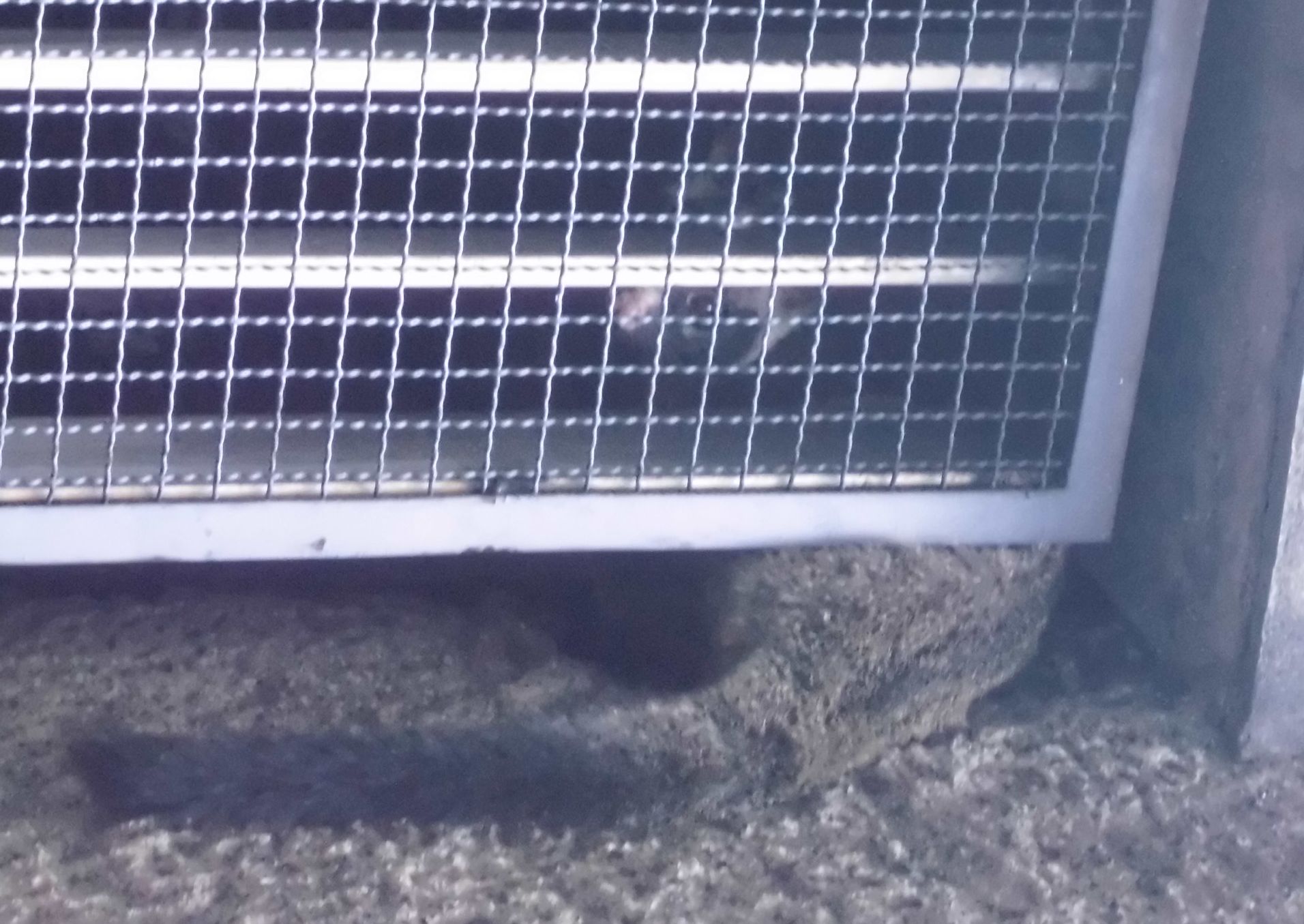
entrance, under the expressway. The glass window in the photo above is the room where north-entrance guards sit. The animal was walking on the brick wall in front.
“A raccoon dog,” the building guard thought, and kept the shutter clicking. It is quite well captured. It also went into a slight hollow nearby (photo at right). To keep people from harm the guard watched from a little distance; around 10:20 it crossed the ward road under the expressway and vanished toward the NTT Hitotsubashi Building and the Sumitomo Corporation Takebashi Building.
What, then, was this visitor’s identity? According to “Tokyo Tanuki Expedition” (http://tokyotanuki.jp/comparison.htm), raccoon
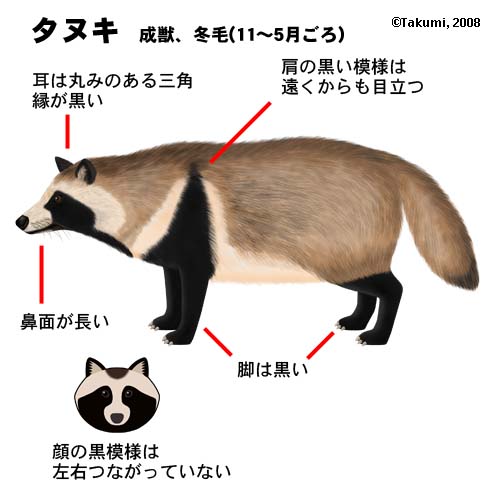
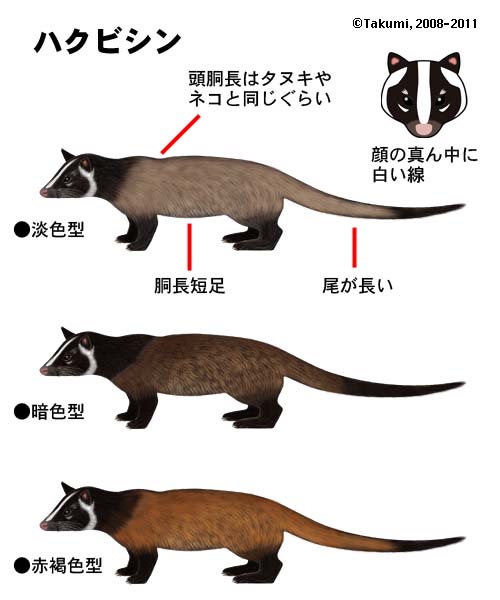
dogs resemble raccoons, masked palm civets, Japanese badgers and the like. Compared with the site’s drawings, raccoon and Japanese badger differ quite a bit, so I compared raccoon dog and masked palm civet (photos at left, above and below). What do you think? From the plumpness of the belly and, above all, whether the tail is pointed or rounded, it is probably a masked palm civet. Raccoon dogs are canids (Nyctereutes); civets are viverrids. Both are basically nocturnal and often rest in dens by day. Did this one come out half-asleep?
Where from? The Imperial Palace, surely.
A paper, “On masked palm civets and raccoon dogs introduced into the Imperial Palace” (Endo Hideki, University of Tokyo Museum, and others), had this summary. (2000; originally in English, a Japanese abstract is online: http://ci.nii.ac.jp/els/110004313491.pdf?id=ART0006482129&type=pdf&lang=jp&host=cinii&order_no=&ppv_type=0&lang_sw=&no=1428909336&cp=)
“Because artificial establishment of civets and raccoon dogs in the Imperial Palace is inferred, interviews were held with the Imperial Household Agency garden section and the Imperial Guard, and feces were collected and analyzed.
Capture records of civets in central Tokyo were also reviewed. Over about two and a half years, many visual records of both species were confirmed over a wide area of the palace. For civets, visual records include reliable photographs, and two were captured in Chiyoda-ku streets adjoining the palace. Fecal analysis found large amounts of plant fiber and persimmon seeds, ruling out misidentification of dogs and suggesting civets or raccoon dogs may live there. Direct and flotation microscopy of feces found no oocysts or eggs; parasite infection was not shown. For raccoon dogs, no field sign more certain than visual records was obtained. These results prove that civets live in the palace. They also suggest the possibility of resident raccoon dogs. In both cases, residence in the palace is inferred to stem from animals brought into the city as companions and released.”
That civets live in the Imperial Palace seems certain, so surely one of them wandered out.
The paper says “artificial establishment is inferred,” so the idea is that pets bred. When they began to live there is unclear from other records; whether someone brought them, they escaped and settled, or they moved in naturally from the suburbs, there seems to be no definitive record.
In any case, this civet must have been frightened. Imagining its feelings, one cannot help but sympathize. We can only pray it returned safely to its den.