

Suwa Masato, who wrote 6,354 installments of The Mainichi Newspapers’ front-page morning column “Yoroku” over 23 years and two months,
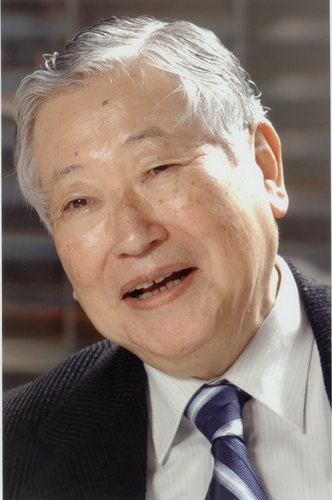
died on February 8 (photo at left). He was 84. Kono Michikazu, editor of Shinchosha’s quarterly Kangaeru Hito, wrote a memorial in his weekly mail magazine (issue 624, February 26) and introduced a “Yoroku” on the pigeon sculptures at Palaceside Building (photo above). (http://www.shinchosha.co.jp/kangaeruhito/mailmag_html/624.html)
Six pigeons sit on the ninth-floor eaves. Suwa wrote about them in “Yoroku” on October 14, 1984, the day before Newspaper Week (the last photo is that page). Before The Mainichi Newspapers moved to Palaceside Building in 1966, when the head office was in Yurakucho, newspapers kept carrier pigeons with communication tubes to carry copy and film. Suwa noted that their role ended with the Tokyo Olympics (1964) and wrote lightly of the sculptures: “Some pigeons look toward Nagatacho. Are they watching for hawks?” A phrase that would still work in this morning’s column.
Reading “Suwa Masato’s Yoroku” (The Mainichi Newspapers)=
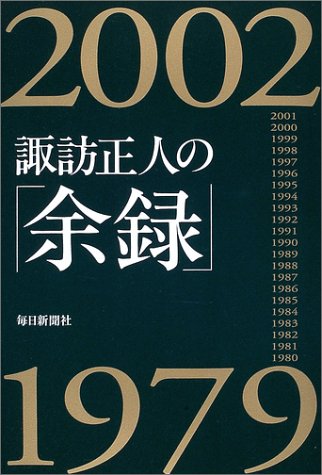
photo at right, a selection of 500 pieces he himself chose, editor Kono writes: “They are short texts of a little over 700 characters, but heart’s blood is poured into each. If the writer is ‘a hen that lays one egg a day’ (The Mainichi Newspapers ‘Reporter’s Eye,’ June 25, 2002), the reader too must take one tale a day.” He speaks of a kind of crossing of swords between writer and reader, cites Suwa’s simile that page-one news is “a dressed-up studio photo” and the column “snapshots an amateur takes casually here and there with a small camera,” and explains: “What matters is imagination. Looking down from high as a bird’s eye, or looking up from the ground as an insect’s eye—all are products of imagination.” In that flow, choosing the Palaceside pigeons as a representative Suwa piece, I imagine, connects to imagination’s “bird’s eye.”
Editor Kono closes the column with these words.
“Having said farewell to ‘living day to day’ with days that drift by, ‘Yoroku’ now stands before us as a single book. Refined humor, learning that seeps between the lines, a reporter’s soul hidden in a leisurely stance—. ‘A mere few hundred characters of column can make you merry and give you energy. Courage to live somehow wells up. Mainichi readers must remember that,’ wrote Maruya Saiichi, one devoted reader, of Suwa’s ‘Yoroku.’”
The quarterly Kangaeru Hito began in 2002. According to an interview with the first editor, the founding concept, leaning on Wordsworth’s “plain living, high thinking” amid rapid urbanization after Britain’s Industrial Revolution, was “to ask for the power to think with one’s own head amid overflowing information, and to think about simple living amid overflowing things.”
The Palaceside Building website also explains the pigeons as follows. (https://www.mai-b.co.jp/about/story.html)
“If you look toward a corner of the roof you will notice aluminum-bronze pigeons resting their wings, about to take flight. The building’s designer placed carrier pigeons, once used by newspapers to carry copy, as a symbol of peace and a playful design touch on this building, which The Mainichi Newspapers still occupies. The artist is Isshiki Kunihiko, who won the Takamura Kotaro Prize for sculpture around the time the building went up and has since made many prizewinning works.”
