

On the roofs of Palaceside Building’s east and west elevator towers, slender scaffolding is up, wrapped in blue covers. To be precise, the photo above was taken February 19; the west cover (left in the photo above) is already off. The east cover (right in the photo above) is coming off gradually and should be fully gone next week (see the three photos at left and below).
A little work is under way; the view is rarely seen, so we are recording it here.
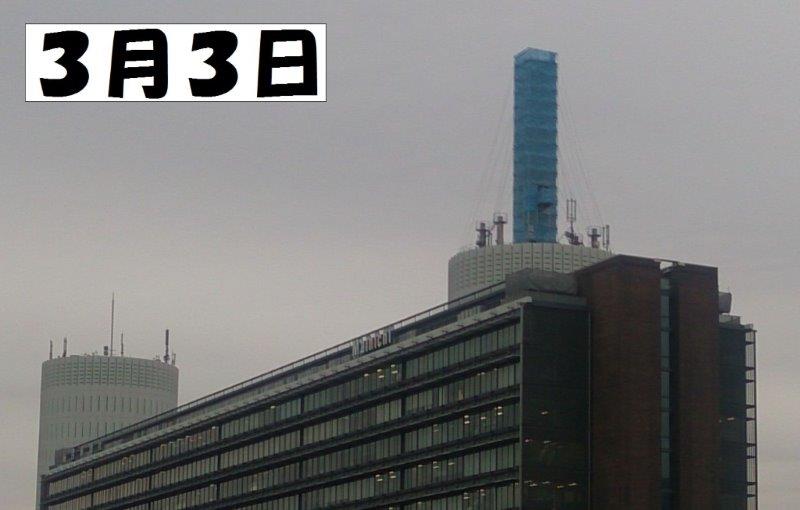
↑ West cover already removed; east pole still hidden
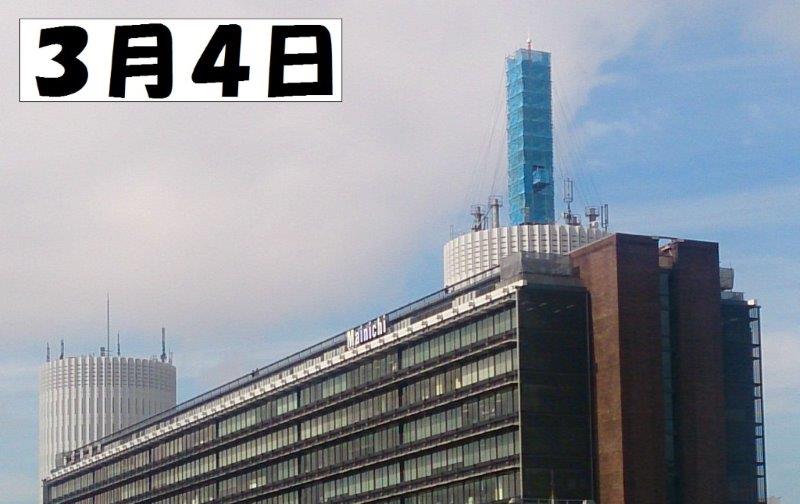
↑ The tip of the east pole peeks out
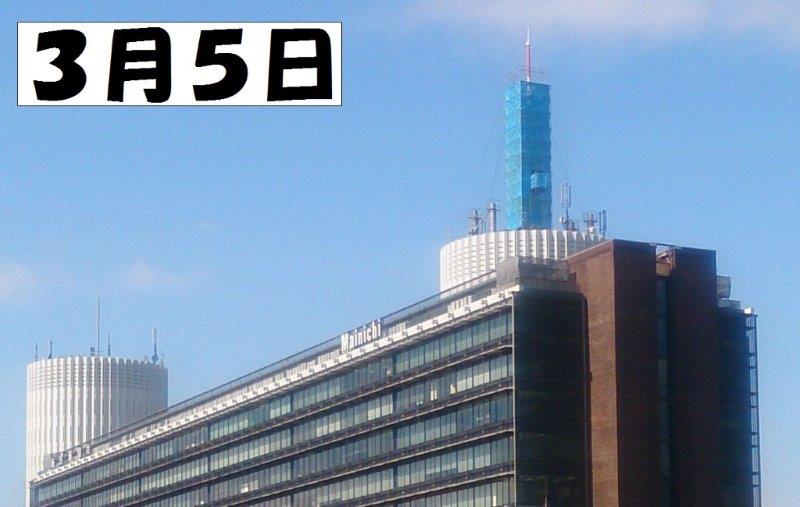
↑ The east pole tip is quite uncovered
The work is repainting the poles that stand here, and more. The poles are antennas that also serve as lightning rods.
Painting we do every few years because they stand in the rain; last time was 2003. What was unusual—or a first—this time was also removing unused antennas. Besides analog-era television antennas, as The Mainichi Newspapers’ head office there were once many radios for exchanging information and for emergencies… that age is past. The main aim was to strip those unused antennas away. Some belonged to tenants who left decades ago; after mergers the original companies were gone, so we had to ask successor firms for consent to remove them—quite a chore.
We also removed the aviation obstruction lights—the red blinking lights that keep aircraft from hitting tall buildings and towers at night. A 1960 law requires them on structures over 60 meters. Palaceside’s nine-story portion is about 37 meters, the elevator towers a little over 50, but the pole tips exceed 80 meters, well over 60, so lights were installed. After several relaxations of the rules, in large cities of clustered buildings, if the whole can be seen from afar as one structure and a nearby taller building has lights, a lower building may omit them. Palaceside was judged no longer to need them. Specifically, under the proviso to Civil Aeronautics Act Article 51(1)—“A person who installs an object 60 meters or more above the ground or water surface shall, as provided by ordinance of the Ministry of Land, Infrastructure, Transport and Tourism, install aviation obstruction lights on that object,” except “when permitted by the Minister of Land, Infrastructure, Transport and Tourism”—MLIT granted an individual exemption.
This work did not raise the building’s functions as such, but we hope you will understand that everyday care, in many senses, is the secret of lasting long.