
The Mainichi Newspapers, headquartered in Palaceside Building, reached 50,000 issues on the 12th—the first Japanese newspaper to do so = photo above. Longevity is not everything, of course, but it is still a happy mark. It is the result of nearly daily issues stacked up over 143 years since 1872 (Meiji 5), when the Tokyo Nichi Nichi Shimbun (Tōnichi), predecessor of The Mainichi Newspapers, was founded.
One point needs explaining: the “50,000” applies only to eastern Japan (the Tokyo Head Office and Hokkaido Bureau, from Shizuoka–Nagano–Niigata northward). In the Chubu, Osaka, and Seibu head-office areas the number on the 12th was 47,581. Today’s Mainichi was formed by merging Tōnichi and the Osaka Mainichi (Daiai) Shimbun, so each region keeps the issue count of its predecessor.
The evening edition shares the morning edition’s number. A year earlier, on February 12, 2014, the count was 49,636, so about 364 issues in a year. One short of 365? Yes: there are normally ten days a year without a morning paper. When the morning paper is off after a Sunday or holiday, the evening paper still comes out and the number rises, but on January 2 the morning paper is off and there is no evening paper over the New Year, so that day is not counted. At this pace it will take a little under 30 years
to add another 10,000 issues.
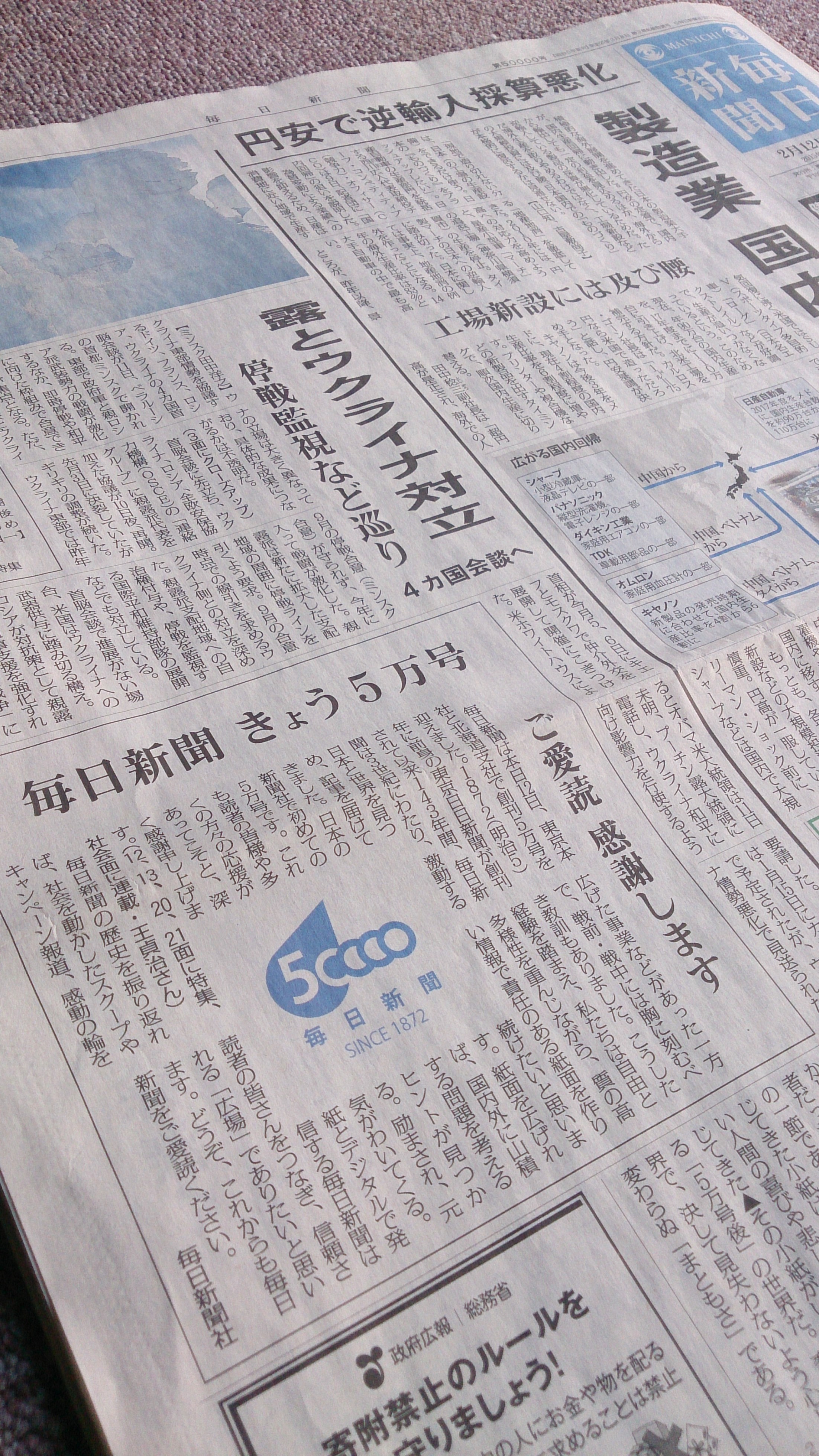
The morning paper of the 12th, the 50,000th issue, promotes the milestone. A boxed item at lower left on page one says “The Mainichi Newspapers reaches 50,000 issues today / Thank you for reading” = photo right, and inside there are four pages of spread features.
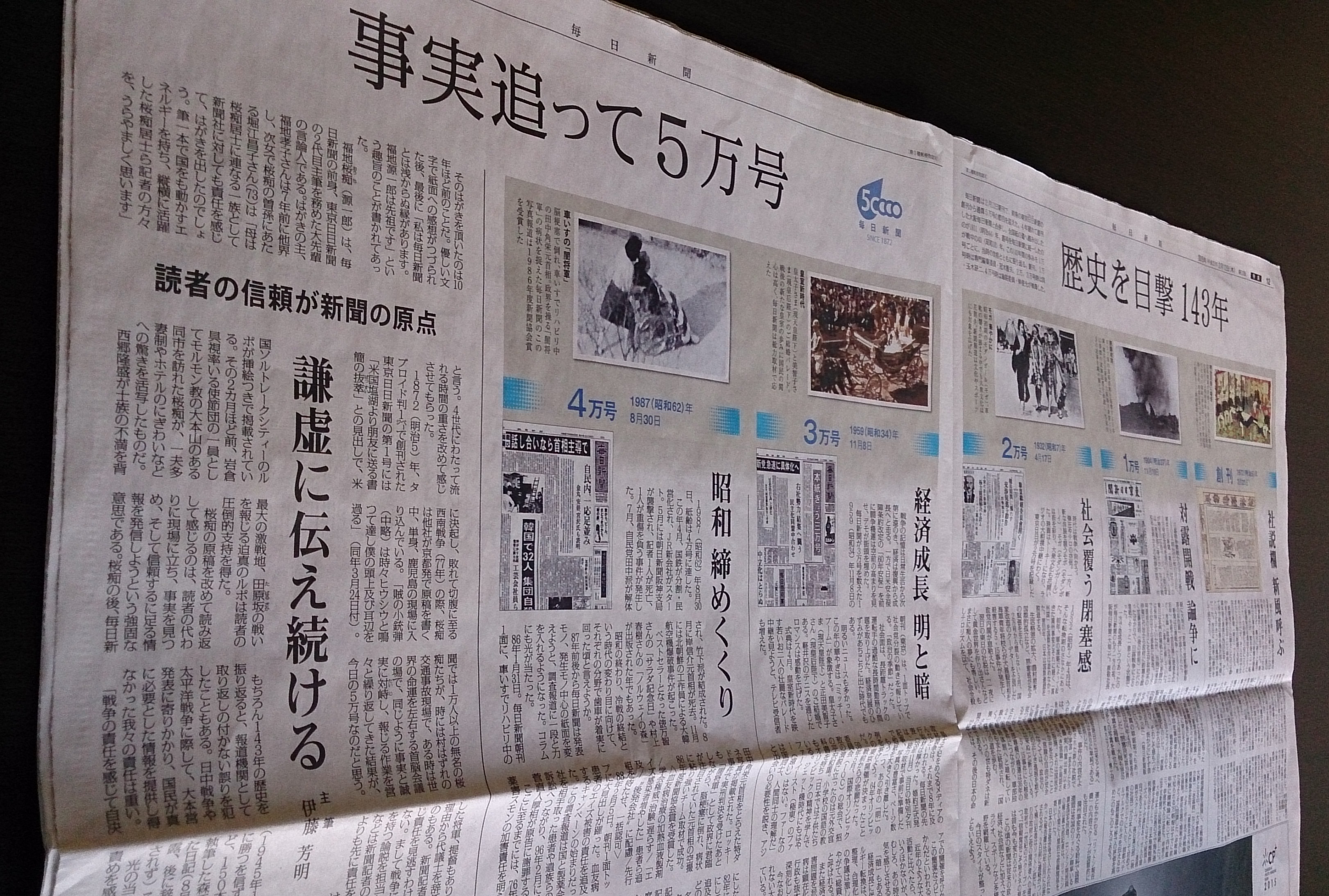
The first feature (pages 12–13 in the Tokyo Head Office final) = photo below explains social conditions around founding and the 10,000th, 20,000th, 30,000th, and 40,000th issues.
・Founding: two years later, in December 1874, it created an editorial column and led other papers to keep one
・It reached 10,000 during the Russo-Japanese War
・20,000 in 1932 followed the Manchurian Incident the year before and the May 15 Incident in May 1932; after the February 26 Incident the next year, press freedom faded
・30,000 after the war, in 1959, came as the economy entered high growth: bright news of the Crown Prince (today’s Emperor) marrying Michiko Shoda (today’s Empress), and also the Mitsui coal-mine labor dispute called a “showdown of all capital versus all labor”
・40,000 (1987) was a closing chapter of the Showa era, including the end of the LDP Tanaka faction “shadow shogun”; aerial photos of former Prime Minister Kakuei Tanaka in a wheelchair in his garden after a stroke won the 1986 Newspaper Publishers Association Prize
——and so on.
The other feature (pages 20–21 in the Tokyo Head Office final) looks back at how type and images changed.
The page-one box says the paper wants to keep making responsible pages of high-quality information while valuing freedom and diversity, looking toward 60,000. What kind of era will it be in about thirty years?