
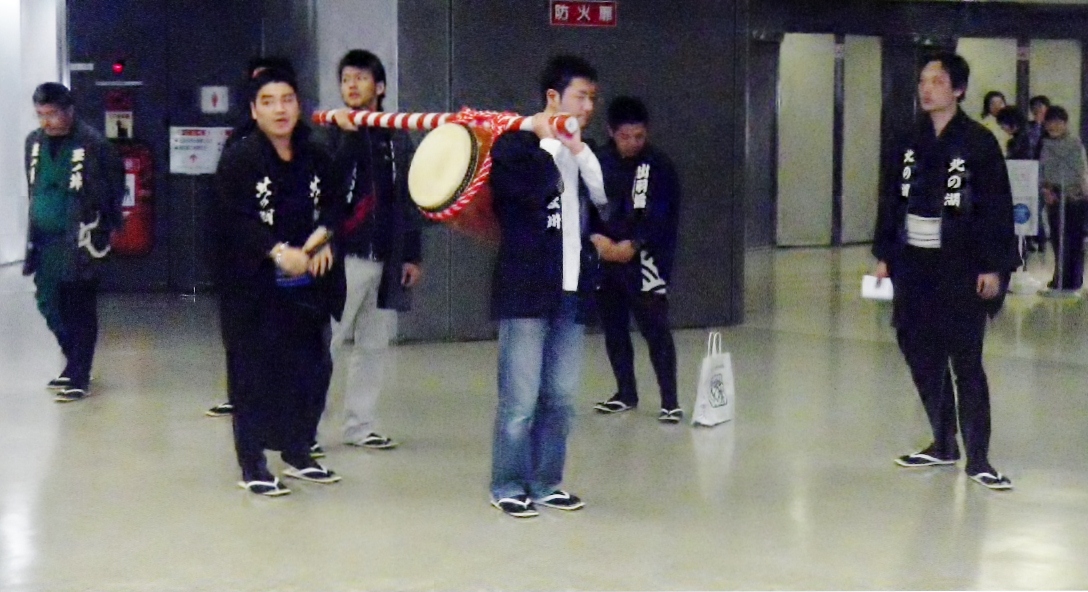
The autumn sumo tournament has begun. The day before opening, Saturday, the "fure taiko" drum parade visits Palaceside Building (no photos this time; photos right bottom are from Jan. 7, 2012)—fitting for The Mainichi Newspapers, which invests in sumo coverage and sponsors the championship prize.
Sumo means Ryogoku. Do you know that the Great Fire of Meireki (1657), which I've written about before, made Ryogoku sumo's mecca?
Built to mourn the tens of thousands—some say over 100,000—lost in the Meireki fire
is Eko-in in Ryogoku (Sumida 2-8-10), as I wrote on March 14. On its grounds, kanjin sumo to fund temple rebuilding and repairs began in the Edo period.
Per Eko-in and Tokyo Metropolitan Library sites, the first recorded kanjin sumo in Edo was at Fukagawa Hachiman in 1684 (Jokyo 1), then shrines and temples including Kuramae Hachiman, Shiba Shinmei, Eko-in, Ichigaya Hachiman, and others. At Eko-in the first event was 1768 (Meiwa 5); after the Tenmei era (1781–89) Eko-in became the main venue; from 1833 (Tenpo 4) it held spring and autumn exclusively for 76 years until the old Ryogoku Kokugikan opened in 1909 (Meiji 42)— regarded as the origin of
grand sumo. Thus Ryogoku became sumo's holy ground.
Top photo: Hiroshige's Tenpo-era "Famous Places of the Eastern Capital—Full View of Eko-in Grounds." Left is the main hall; the huge yoshizu-walled building right is the sumo hall. Drum beats from the tower outside the gate announced kanjin sumo to Edokko.
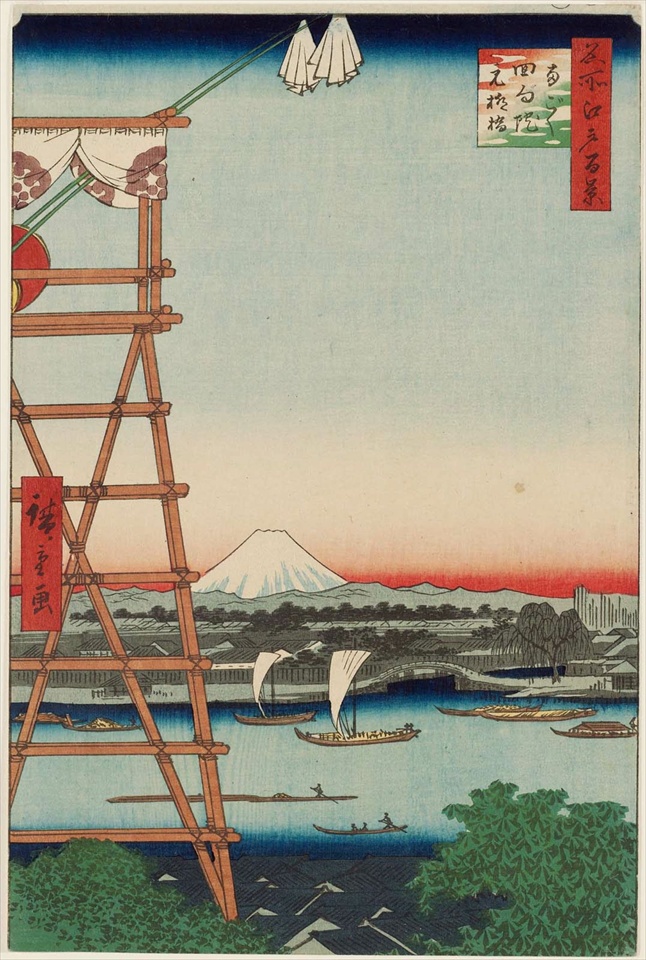
Left: Hiroshige's "Ryogoku Eko-in Motoyanagibashi"—Eko-in tower in front (the temple itself not shown), Sumida River beyond, Motoyanagibashi over Yakurimbori, Fuji in the distance. Sunset gradient— superb composition. Pair the two prints and imagine the layout.