

NHK's taiga drama Gunshi Kanbe, whose ratings had been sluggish, seems to have turned around along with the late-July episode on the reversal in China. Episode 29, "Secret Strategy for the Realm," hit a series-high average of 19.4% (Video Research, Kanto)—and now, after the face-off between Tokugawa and Toyotomi, Kyushu entered the story last Sunday.
Kanbe, now under Toyotomi, backs Otomo Sorin, the Christian daimyo of Bungo, and with the Mori clan blocks Shimazu's invasion from Satsuma. He sets headquarters at the foot of Mt. Kagamiyama in Buzen.
Next week (Aug. 31 broadcast): March, Tensho 15—Hideyoshi finally campaigns in Kyushu (or so we expect?). His army crosses to Kyushu and first enters Kokura Castle in Buzen. Last week's episode showed the last days of Yoshikawa Motoharu (Mori Motonari), who resisted joining the march with Kuroda until the end. Motoharu was the second son of Mori Motonari, famed for "Three Arrows"; though retired, he joined the Kyushu campaign despite illness. Ravaged by a suppurative inflammation (possibly cancer), he marched to prove the Mori clan's loyalty to the Toyotomi and died in the ninomaru of Kokura Castle at 57.
Last week I traveled on Palaceside Building business to the Mainichi Western Office (Kokurakita, Kitakyushu) and the Mainichi Fukuoka Hall (Chuo, Fukuoka).
On the side I dropped by Kokura Castle Park. The original founding date is unclear, but the castle is said to have been built mid-13th century on a hill at the west bank of the Shisen River mouth. In Keicho 7 (1602) Hosokawa Tadaoki is credited with a Nanban-style keep—regarded as the Hosokawa build. Of course, what stands today is a
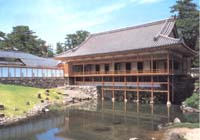
reconstruction. In 1959 (Showa 34) a reinforced-concrete keep restored the exterior; inside is a local history museum.
As in today's main photo, the view of Kokura Castle from the castle garden is quite fine. This garden =photo top= opened September Heisei 10 on the site of the karō residence east of the castle—a rare nationwide "etiquette theme" recreation of a daimyo mansion. Enter freely through the kugurido gate. A hidden spot for castle views.
The meeting trip continued in Fukuoka the next day.
Back to Kanbe: after pacifying Kyushu, Hideyoshi orders him and Ishida Mitsunari to rebuild Hakata, burned bare in the war between Otomo and Shimazu—wealth through trade and hearts weary of war. The plan worked; Hakata people still call it "Taikō machiwari." Merchants helped carry out the "Taikō machiwari" urban renewal in two stages—Hakata remains tidy. Multiple towns in this layout formed "nagare" units for Hakata Gion Yamakasa floats—and
that is how it stands.
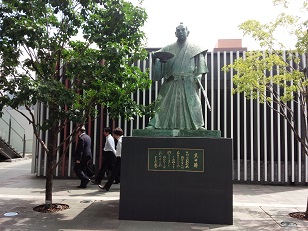
At JR Hakata Station stands a samurai with spear and cup =photo right=—Mori Tajima-no-kami Tomonobu, known as Mori Tahei. Famous from Kuroda-bushi for winning the spear "Nippon-go" from Fukushima Masanori; played convincingly by Hayami Mokomichi.