

About ten days left of summer vacation. Time to think about free-research homework before the new term. Still hot—and parents dragged everywhere have it tough.
The National Museum of Nature and Science—useful for homework and fun beyond. From Palaceside Building, Takebashi Station exit 1b on Tokyo Metro Tozai Line directly below: 550 m, ~7 min. Cross Takebashi intersection before The Mainichi Newspapers, cross Takebashi bridge, pass the National Archives, turn right before the pedestrian bridge—the museum is on your right.
Slogan: "Summer at the science museum is packed with fun! Be amazed by sea life." Special exhibition "Sea!—Set Sail for a Mysterious World!" Aug 9–25, 2014.
Mysterious deep-sea creatures. Advances in science gradually reveal the deep ocean. Living specimens, samples, and video introduce astonishing forms and ecology. Below 200 m—dark, high pressure, cold, low oxygen—survival seemed impossible, yet better submersibles show abundant life.
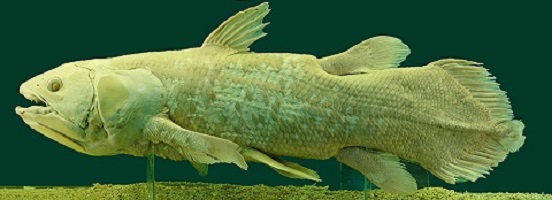
Highlight: coelacanth juvenile specimen. Coelacanths =photo= are called "living fossils."
The coelacanth order was known from many fossil species since the Devonian, flourishing worldwide until nearly all extinct around 65 million years ago. In 1938 a living species was confirmed off northeast South Africa, shocking the world—that species symbolizes coelacanths. In 1952 the Comoros, 1997 Indonesia—called the Indonesian coelacanth in Japanese. These two are "living fossils."
Paleozoic and Mesozoic coelacanths are thought to have lived widely in freshwater and shallow seas in varied sizes—some restored to 3 meters. Both living species inhabit the deep sea and prey on fish and squid.
Besides sea-life displays, latest survey technology is featured—including deep-sea robot system "PICASSO."
2nd-floor event hall, 9:30 a.m.–4:50 p.m. (admission until 4:00). Entry free; museum admission separate.