

The other day I showed workers clinging to the Hirakawa-bori wall of the Imperial Palace (Edo Castle) near Takebashi, pulling plants from the joints. Walls one usually glances at, seen steadily, are beautiful; looking them up, there is much variation by era, place and more. In the Sengoku period there were castle-building masters; in Edo peace, appearance mattered more than real defense. Quite deep.
So, a report. First, basics: classification.
By stone shape and working — stacked as found, or dressed, and how much. In order of technical progress: (1) nozura-zumi, (2) uchikomi-hagi, (3) kirikomi-hagi. “Hagi” means joining.
Nozura-zumi stacks natural stone as is; many castle walls of the earlier period (Sengoku to Azuchi-Momoyama) are of this type. Some are set with a flat face out, but sizes and shapes are basically mixed. Gaps and projections are many; small stones fill gaps for strength. It looks casual and unstable, yet many have stood for centuries. A wall must bear the fill behind and water pressure when rain soaks in; a gappy nozura-zumi sheds water naturally and is surprisingly stout.
Uchikomi-hagi knocks corners and faces flatter to reduce joints. After Sekigahara (1600), western-domain lands were confiscated and given to eastern generals; a castle-building rush followed, and this was the peak of uchikomi-hagi. The working is not “high-tech”; since Asuka, skill was ample — even Horyu-ji’s five-story pagoda and kondo, the world’s oldest wooden buildings, use precisely cut stone. It spread after Sekigahara for efficiency. Nozura-zumi of mixed local stones is quick in a small area, but for large quantities it is more efficient to cut from a quarry to preset sizes and simplify the site. Mass production for a castle rush.
Kirikomi-hagi dresses stone thoroughly and stacks with almost no gap. Not identical like concrete blocks, but sizes are evened. Drainage openings are a feature. After the 1615 Osaka Summer Campaign destroyed the Toyotomi and no one in Japan opposed the Tokugawa, the one-castle-per-domain law razed extra castles and the Buke Shohatto limited repairs; the castle as defense lost meaning. As a symbol of authority it needed artistry, and the kirikomi-hagi age began. Large building then declined, so from a peak around Genroku–Hoei (c. 1700) the craft is said to have begun to fade.
There is also classification by stacking
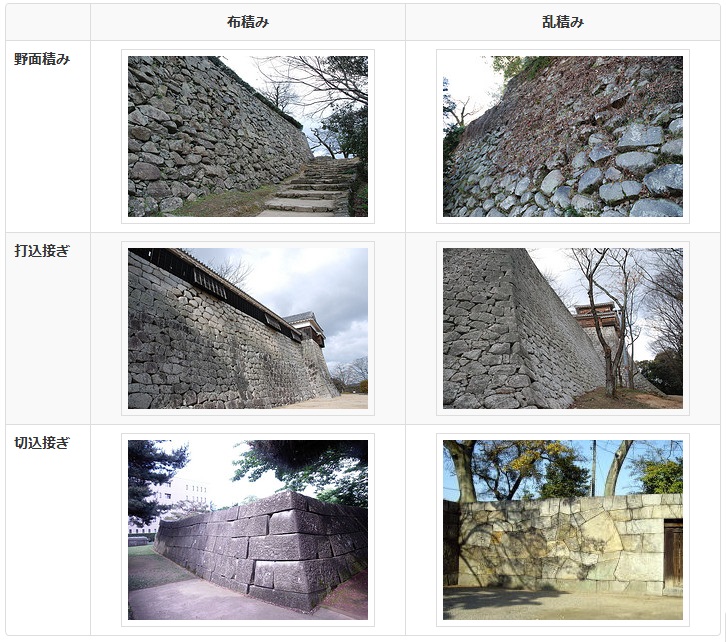
method. “Nuno-zumi” aligns joints in a horizontal line — neat, a bit weaker. “Ran-zumi” stacks irregularly without caring for joints — the harder “craftsman’s” way.
The three working types and two stacking types combine into six, which roughly cover stone walls (photo at right is a website’s table).
There is also “classification by appearance.” “Sangi-zumi” stacks long stones at a corner alternately long and short for strength. Tani-zumi tips nuno-zumi 45 degrees; it is still used in road work. “Kikko-zumi,” a kirikomi-hagi that cuts hexagons, also exists.
The top photo is the Ishikawa-mon wall at Kanazawa Castle; left and right differ. Left is uchikomi-hagi, right kirikomi-hagi. A nearby plate says it is “thought to be from a Meiwa 2 (1765) repair,” without saying why. Was the left left as old and only the right rebuilt
cleanly? One imagines.
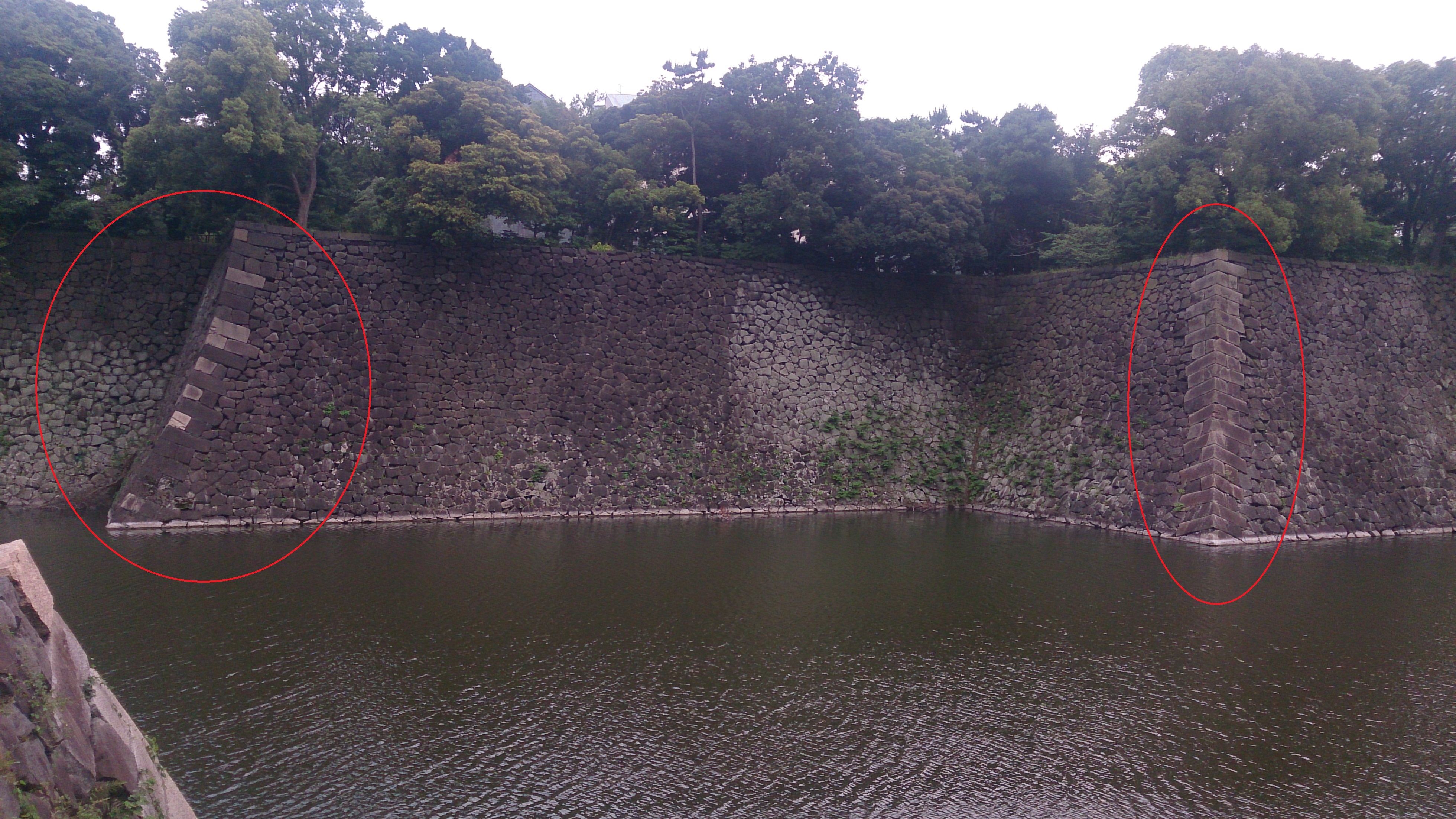
Edo Castle shows many walls; I will introduce them again. At Hirakawa-bori (photo at left) the moat walls are generally uchikomi-hagi. The circled part is typical sangi-zumi. Corners would be weak without it.