

As soon as the rainy season began, wet days continued. Last Saturday and Sunday finally showed some sun, but more rain is likely. This year the amounts are large; late last week a low on the Baiu front brought heavy thunder rain to Kanto-Koshin. The end of the rains is forecast after July 20. Last year the rains began three days later than this year but ended early on July 6, then jumped to fierce heat; this year’s end is forecast 15 days later than last year’s.
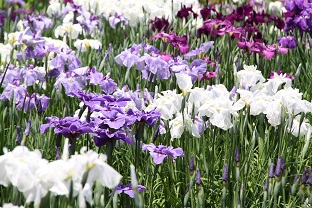
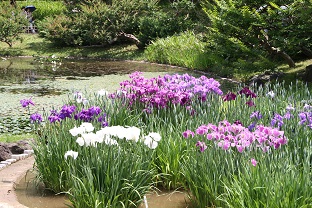
The irises in the East Gardens of the Imperial Palace bloom splendidly every year at this season; they are now at their peak. Near Hirakawa-mon, not far from Palaceside Building, they stand packed in the iris beds of the Ninomaru garden. Hirakawa-mon is very close to Tokyo Metro Tozai Line Takebashi Station, convenient; through the Honmaru site one can also reach Kitanomaru Park. It is a place for many flowers and walks, not only irises. From Ote-mon the iris beds are about as far as from Hirakawa-mon.
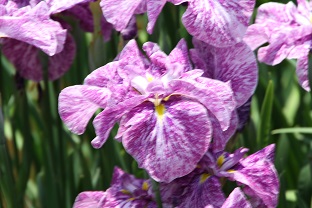
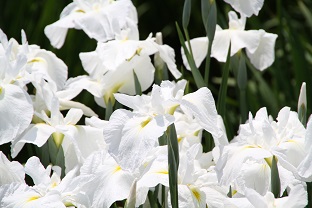
Eighty-four kinds of hanashobu are planted. Each clump is kept together with a wooden name tag. Since 1966 (Showa 41), while the East Gardens were being laid out, stock was received from the Meiji Jingu iris beds and carefully grown. In 1992 (Heisei 4), when disease spread in the Jingu iris garden, stock was divided back from the Ninomaru beds.
As for the name. At Tango no Sekku the custom grew of displaying flowerless ayame (iris), and the June-blooming ayame came to be called hana-ayame (flower iris). As breeding advanced and warriors favored them, the characters for ayame were punned toward “victory” (shobu), and the word hanashobu is said to have been born.
Ayame is also written with characters for “pattern,” “twill” and “Chinese woman,” each with a story. The irises in the Ninomaru beds of the East Gardens have names such as O-murasaki, Komachi-musume, Gosho-asobi, Edo-jiman, Shishi-ikari, Tama-hoko, Sake-daihai-naka-no-hana and Shinso no kajin.