
This blog has, over three posts (November 2013), introduced the Kanda sewer near Palaceside Building at Takebashi and the sewer of Yokohama’s old foreign settlement. Which was Japan’s oldest? Yokohama was built first, but as an extraterritorial settlement I wrote that in “Japan” Kanda came first.
Further checking, though, the real first in Japan seems to be neither Kanda nor Yokohama but Kobe.
With the 1858 (Ansei 5) Treaty of Amity and Commerce, Kobe was slated to open with Nagasaki, Yokohama, Niigata and Hakodate, and a foreign settlement was to be laid out. In the unstable bakumatsu years the opening slipped to 1867 (Keio 3). The settlement was set southwest of today’s JR and Hankyu Sannomiya stations, just south of Motomachi, and the first land auction was in 1868.
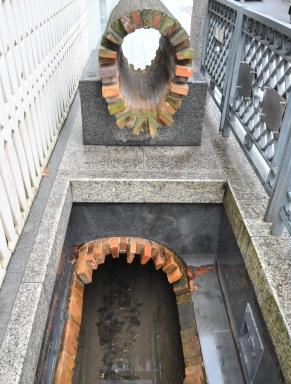
The magazine Construction Management Technology (May 2008) says the settlement was built under British civil engineer John William Hart. The sewers used domestic brick fired near Kobe: circular pipes about 90 centimeters in diameter and egg-shaped pipes about 40 × 54 centimeters. Six lines along north–south streets totaled about 1,880 meters. About 90 meters still remain east of Daimaru and in front of Former Settlement Building No. 15 (photo above), the only surviving settlement-era (1868–99) building, and still serve as a storm trunk. Their historic value was recognized in 2004 (Heisei 16) when they were registered as the “Former Kobe Settlement Brick Sewers.”
The question is when they were built. The magazine says completed in 1883 — wait, Meiji 5 is 1872 — and the Kobe city site (http://www.city.kobe.lg.jp/culture/culture/history/kakawari.html) says “around Meiji 5, circular and egg-shaped brick sewers were completed.” The Agency for Cultural Affairs “national cultural-property database” for registered tangible cultural properties (buildings) gives “Meiji 2–4 (1869–1871).” The magazine calls them “among the oldest modern sewer works in Japan, alongside Yokohama,” but Yokohama finished tile-pipe sewers in 1871 (Meiji 4) and
laid about four kilometers of brick egg-shaped pipe in 1881–87; the Kanda sewer was built in 1884–85. Kobe is clearly earlier.
The pipes can still be seen. In front of Former Settlement Building No. 15, around to the right as you face it, a patch of road is opened so the brick pipe below can be viewed. It looks circular; beside it an egg-shaped-pipe monument is also shown (photo at left). If you are nearby, it is worth a stop.