

To prepare for urban flooding from typhoons and cloudbursts, Palaceside Building again held a flood-defense drill. A three-month outlook from the JMA’s Global Environment and Marine Department says eastern Japan’s rainfall this year will be near or below normal in June, the first half of the rainy season, and near or above normal in July, the second half. Guerrilla downpours also seem more common lately.
Participants numbered 43: Mainichi Building staff plus security, facilities and cleaning. Items this time: closing flood doors at two points, closing flood boards at the underground parking, checking flood-risk spots and gear, and confirming where emergency stores are kept.
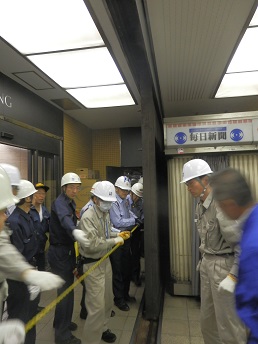
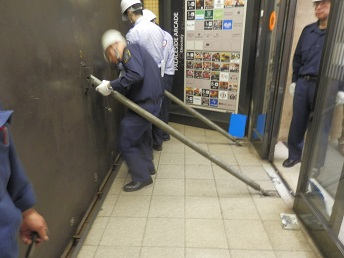
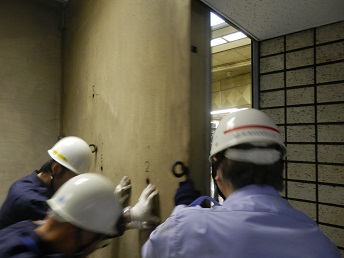
[Photos, top three] First, a drill to seal with flood doors the two building entrances in front of the escalators that lead to the B2 ticket gates of Tokyo Metro Takebashi Station. The doors are normally hidden and must be pulled out; the manual’s steps have to be followed exactly. Each door is about 20 centimeters thick and reaches the ceiling. They are heavy and run on rails that are themselves covered in ordinary times. Floor covers come off to expose the rails, which are oiled so they slide. Hidden or not, the drill is once a year, so the rails are oiled with care. Ceiling covers come off the same way. The door is drawn out beside the station shop, braced with steel bars and fixed. The door is fairly large; in an emergency four people are assumed. Everyone joined at key points so the full sequence could be done in about 20 minutes and learned by the body.
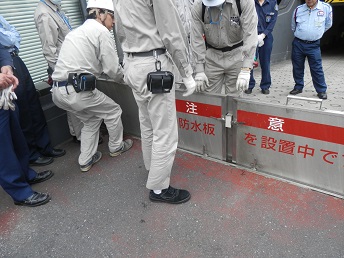
[Photos, bottom two] After lunch we drilled the remaining flood door and set flood boards at the top of the parking-entrance ramp.
Then we checked inundation-risk spots around Palaceside Building. Walking the perimeter, everyone reconfirmed places that need sandbags quickly — gaps at the automatic entrance doors, gaps in the planting blocks beside the entrance, and so on.
Last came inspection and upkeep of sandbags and a check of where emergency stores are kept.
From now on, while watching rain, wind and typhoon reports, we will regularly grasp road flooding, moat and Nihonbashi River levels and the building’s flood-risk spots, and keep watch.