

The Tokyo Nichi Nichi (today’s Mainichi) and other papers of the day all played up the lavish wedding of coal king Densuke Kano (Kotaro Yoshida) and Renko Hayama (Yukie Nakama). A princess bought with money, one might say — more a weekly-magazine item now. Last week’s episodes of the high-rated NHK morning drama “Hanako and Anne” sent Hana Ando’s (Yuriko Yoshitaka) closest friend Renko far off to Kyushu, married to a much older coal king. Readers will have seen it.
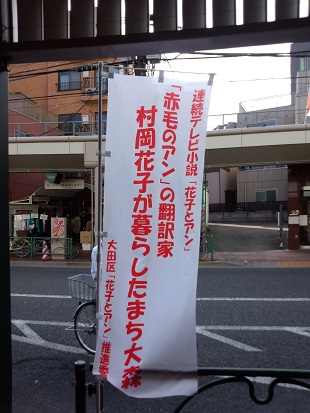
“Hanako and Anne” is modeled on the real translator Hanako Muraoka. Ota Ward, home of the Anne of Green Gables Memorial (her former house), has set up a “Hanako and Anne” promotion office. There is a standing exhibit at Ota Bunka no Mori (the old ward office), and the previous Ota Ward newsletter used a full tabloid front page for a special talk between Mayor Matsubara and the sisters Mie and Eri Muraoka (Hanako’s granddaughters). In the shopping street near JR Omori Station, banners in vermilion read “Omori, the town where Anne’s translator Hanako Muraoka lived” (photo above).
NHK serials help local tourism — or rather, localities use them to boost it. In the same way, Iizuka City in Fukuoka Prefecture is watching the landmark “Former Ito Denemon Residence.”
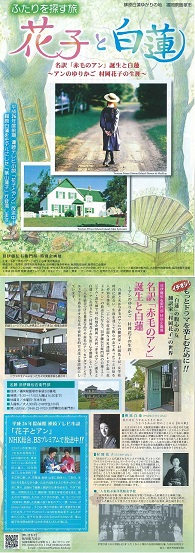
Yes: the drama’s Densuke Kano also has a real model, Denemon Ito, who rose from nothing to “coal king” of Chikuho.
Byakuren Yanagiwara, the model for Renko Hayama, married Denemon and lived in this house. It is now a tourist site as the architecture of a celebrity couple later shaken by the “Byakuren Incident.” Iizuka is promoting “A journey to find the two: Hanako and Byakuren” (photo at center).
Photos of the old house still standing make the luxury obvious. Built in the Meiji 30s, the Ito residence tracks Denemon’s life: a poor childhood, then wealth, then marriage to Byakuren…. With each turn the house was enlarged and rebuilt into a great estate with a fine garden.
In Meiji 44, when Byakuren married in, a third large rebuild added a second floor to what had been a single-story house; that floor became her rooms (photo below). The dining room was a Western room with a table; window glass was specially ordered from Germany; the toilet was a flush type then unseen in Kyushu (now held by the Iizuka City History Museum; Byakuren asked for it). One glimpses the coal king’s will to match the cities.
The marriage later collapsed, but people in Kyushu still speak of Byakuren as a tanka poet. Her salon’s influence on women writers in Kyushu was not small.
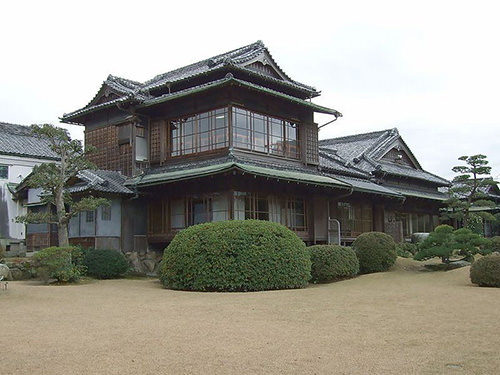
The vast Former Ito Denemon Residence (Sakkukuro, Iizuka, Fukuoka) became city property through a citizens’ preservation movement as coal and cultural heritage, and has been open to the public since 2007.