
-thumb-524xauto-2032.jpg?fit=crop&w=1600&h=900&q=80&fm=webp)
I have been writing that Takebashi and Akasaka each have a Kiinokuni-zaka. Akasaka also has Kioi-zaka, and there was another Kii residence.
Look again, carefully, at a map after the Meireki fire (the 1829 “Bunken Edo oe-
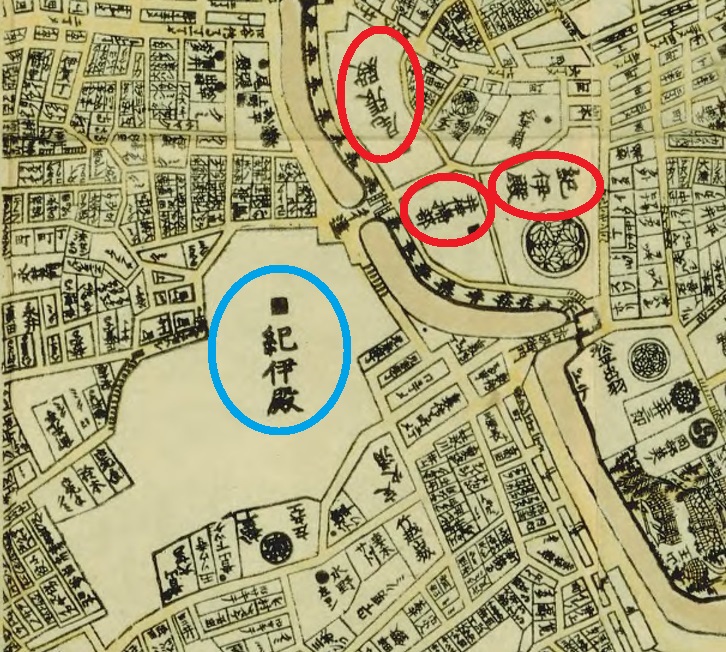
zu”) (photo at upper left) and today (photo at lower left).
The Edo map shows, besides the large Kii residence on the left introduced the other day (blue circle), a small Kii residence at upper right (the rightmost red circle). On today’s map the large residence on the left is the Akasaka Estate with the Togu Palace to the south and the State Guest House to the north,
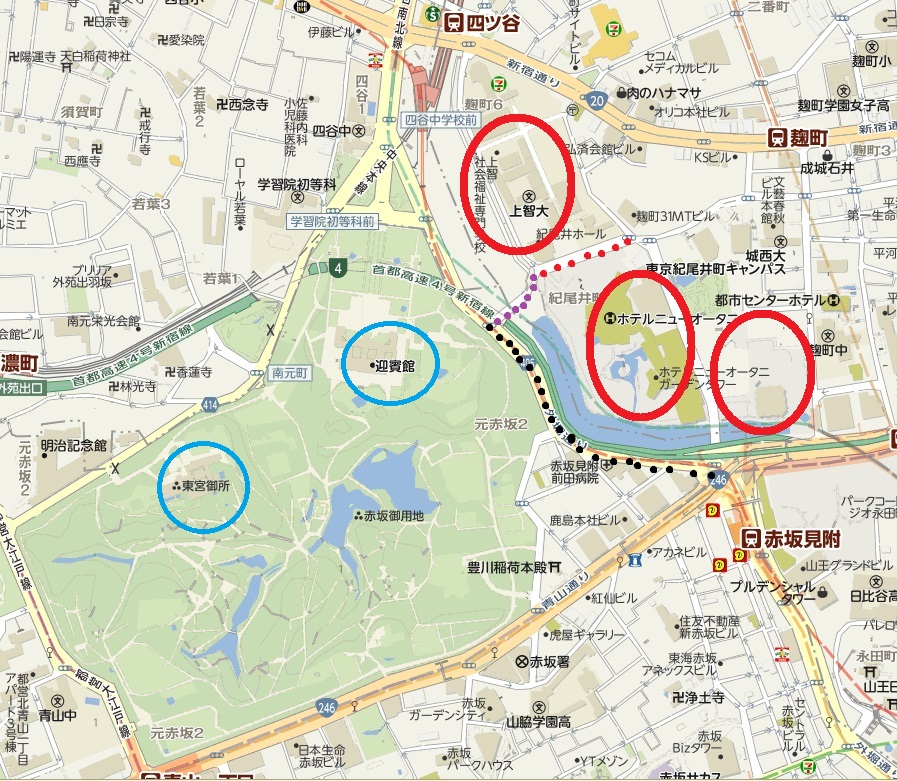
as I already wrote.
West of the small Kii residence at upper right on the Edo map is “Ii Kamon,” and north of that “Owari-dono” (both in red). Ii is the Hikone house of Naosuke Ii, the tairō killed in the Sakuradamon Incident. The initials of the three houses — Ki, O, I — gave today’s Kioicho and Kioi-zaka (the red dotted line on the present map).
From Kiinokuni-zaka (black dotted line) turn east at Kinokuni-zaka crossing, climb Kuichigai-zaka (purple dotted line) to the corner of Hotel New Otani (top photo). Beyond, the left of the photo is Kioi-zaka. Matching the two maps: the Owari site is now Sophia University, the Ii site New Otani, the smaller Kii residence the former Akasaka Prince Hotel (now being redeveloped) and Shimizudani Park.
These three Kioi-zaka houses seem to have replaced the residences near Takebashi that burned in the Meireki fire — all smaller. The central Edo house of a domain (like today’s prefectural Tokyo office) was the “upper residence.” Owari and Ii moved to Ichigaya and near Sakuradamon; Akasaka was a “middle residence” (often for a retired lord or the head’s children).
Kii alone made the small Kioicho house the upper residence. The Guest House site, 140,000 tsubo granted in 1632 (Kanei 9), was the largest of Kii’s Edo houses but remained a middle residence before and after the fire. After the Kioicho upper residence burned in 1823 (Bunsei 6), the Guest House site became the de facto upper residence (Wakayama Socio-Economic Research Institute, “Kishu in Tokyo: the Kishu domain’s Edo residences,” July 2011).
“Fires and fights are the flowers of Edo,” they say. This Akasaka residence had nine fires in 167 years from 1668 (Kanbun 8) to 1835 (Tempo 6), and was repaired each time. To live in Edo was a history of fighting fire.