

It is a pleasant season for a walk. The photo above is from full-bloom cherry time, but the angle looking back as you stroll up the slope from Takebashi along Uchibori-dori toward Chidorigafuchi is a standard Palaceside Building shot.
The gentle slope from Takebashi up past the National Museum of Modern Art and the National Archives toward Kitahanebashi-mon is called Kiinokuni-zaka. A sign appears in the photo above; the text reads as follows.
…The book “Murasaki no Hitomoto” says: “Kiinokuni-zaka is also the slope from Matsubara-koji out to Takebashi-gomon. At today’s Hai-koji there were once residences of the Owari and Kii lords, hence the name.” “Saiko Edo Sunago” says: “Kiinokuni-zaka is the small slope down to Takebashi-gomon. Long ago the Owari and Kii palaces stood here. There is a slope of the same name in Akasaka now.”
The residences of the gosanke, including Kii, that gave the slope its name and stood near Takebashi burned in the Great Meireki Fire of 1657 (Meireki 3).
The Central Disaster Management Council report “The 1657 Meireki Edo Fire” (March 2004) recaps: “From noon to 1:00 p.m. on the 19th of the first lunar month the keep of Edo Castle also caught fire… Around 4:00 p.m. the north wind shifted west, and Nishinomaru, Momijiyama and the gosanke upper residences escaped… On the night of the 19th a fire started in Kojimachi town houses, spread at once and burned about 50 daimyo residences. Many houses in Nishinomaru-shita (today’s Imperial Palace Outer Garden, Chiyoda Ward) were also destroyed.”
The gosanke residences that had once been spared were, in the end, burned by the new fire in Kojimachi
.
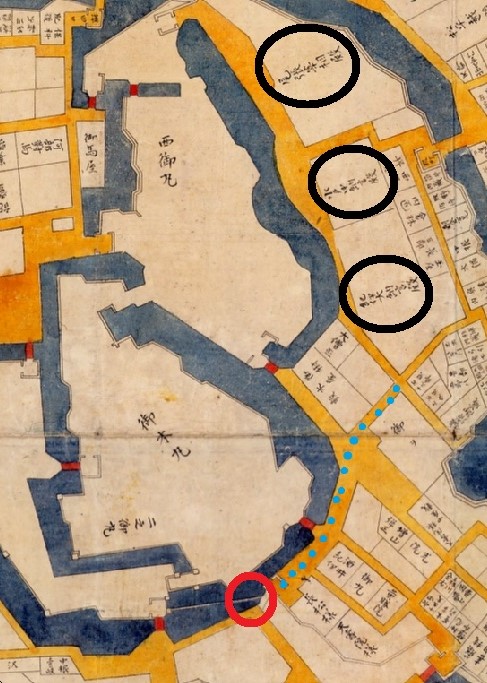
The map at right is part of the “Shoho-nenchu Edo ezu,” thought to show Edo just before the fire, around 1644 (Shoho 1). Facing Nishinomaru, the upper residences of Owari, Mito and Kii (the main Edo houses of the domains, like today’s prefectural Tokyo offices) stand in a row, circled in black. The red circle is about Takebashi; the blue dotted line from there is likely Kiinokuni-zaka. The slope is named Kii, it seems, because the Kii residence stood at the top.
After the fire, the Owari upper residence moved to Ichigaya (now the Ministry of Defense), Mito to Koishikawa (now Koishikawa Korakuen) and Kii to Akasaka. The three sites were left vacant after the fire and now lie within the Imperial Palace grounds.
As the sign says, Akasaka has a slope of the same name. The other Kiinokuni-zaka another day.