

Today, May 1, and tomorrow the 2nd, the Meitankai shops on B1 and the first floor of Palaceside Building are giving koinobori-pattern Kintaro-ame (photo above) to the first 1,500 customers. The koinobori and musha-nobori in the atrium corridor stay up through tomorrow, May 2. Carp streamers are properly flown through Children’s Day on May 5, but the building is generally closed over the holiday; apologies.
Decorations at home (though in Tokyo a private koinobori is now rare) will last through this break as well. Did you know that old koinobori were “Father” only? The custom is commonly traced to an anecdote in the Book of the Later Han, one of the Twenty-Four Histories. Many fish tried to climb the falls called Dragon Gate on the Yellow River;
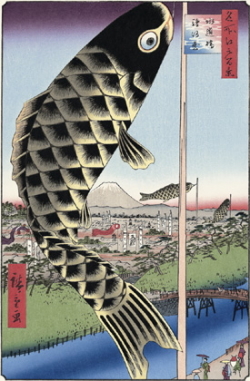
only the carp made it and became a dragon. Carp climbing the falls thus became a symbol of success. From mid-Edo, people put them up at Tango no Sekku to share that luck. Originally there was only the black magoi; wealthy town houses added five-color streamers. “Like Father posted away alone,” someone will say — exactly. In Edo, Father carp climbed the falls solo. (The print at upper right is Hiroshige’s “Suidobashi Surugadai” from One Hundred Famous Views of Edo. Edo koinobori are black only.)
Times changed. From the Meiji era, magoi and higoi were flown as a pair. A couple, then?
No.
You know this lyric:
Higher than the roof, the koinobori
The big magoi is Father
The little higoi are the children
Swimming as if they are having fun
The children’s song “Koinobori.” It first appeared in “Ehon Shoka Haru no Maki,” published December 1931 (Showa 6). Listen closely: there is no Mother. In early Showa, Father and the children swam in the sky while Mother kept the house — or perhaps it was a father-and-child household.
As the Showa
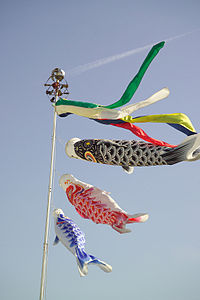
years went on, a blue child carp was added to stand for the family, and that became the mainstream (photo at left). The higoi that had been the children quietly became Mother. Lately greener and orange child carp have spread; in some places families fly a carp for every member, including girls.
Tango no Sekku, and Kintaro (sometimes Momotaro), are a parent’s wish that a child grow strong.