
In pro baseball’s Central League the Hiroshima Carp are flying. As a fan of some decades I am feasting while it lasts. “Feasting” — (*´Д`) what decade is that word from?
Anyway (what kind of “anyway”?), the usual koinobori and musha-nobori have gone up this week in the central corridor of the B1 and first-floor arcade at Palaceside Building. They delight not only people who work in the shops but visitors who stop in after seeing the Imperial Palace cherries.
The Palaceside Building Meitankai (chair: Sen Nakajima, president of Akasaka Hanten), a volunteer group of restaurants and shops in the building, has put them up at this time of year for five years so that people using the building can touch a seasonal Japanese custom.
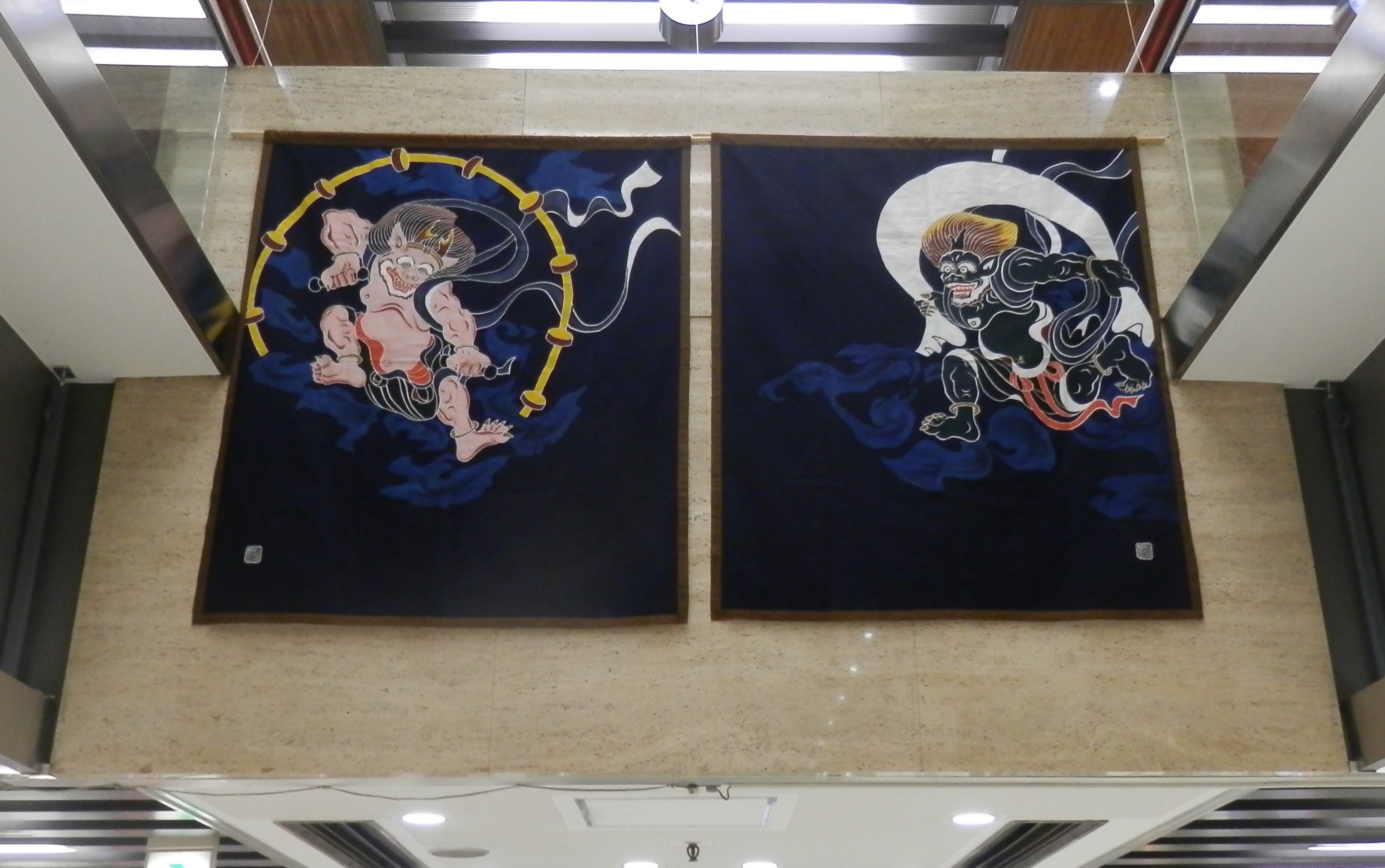
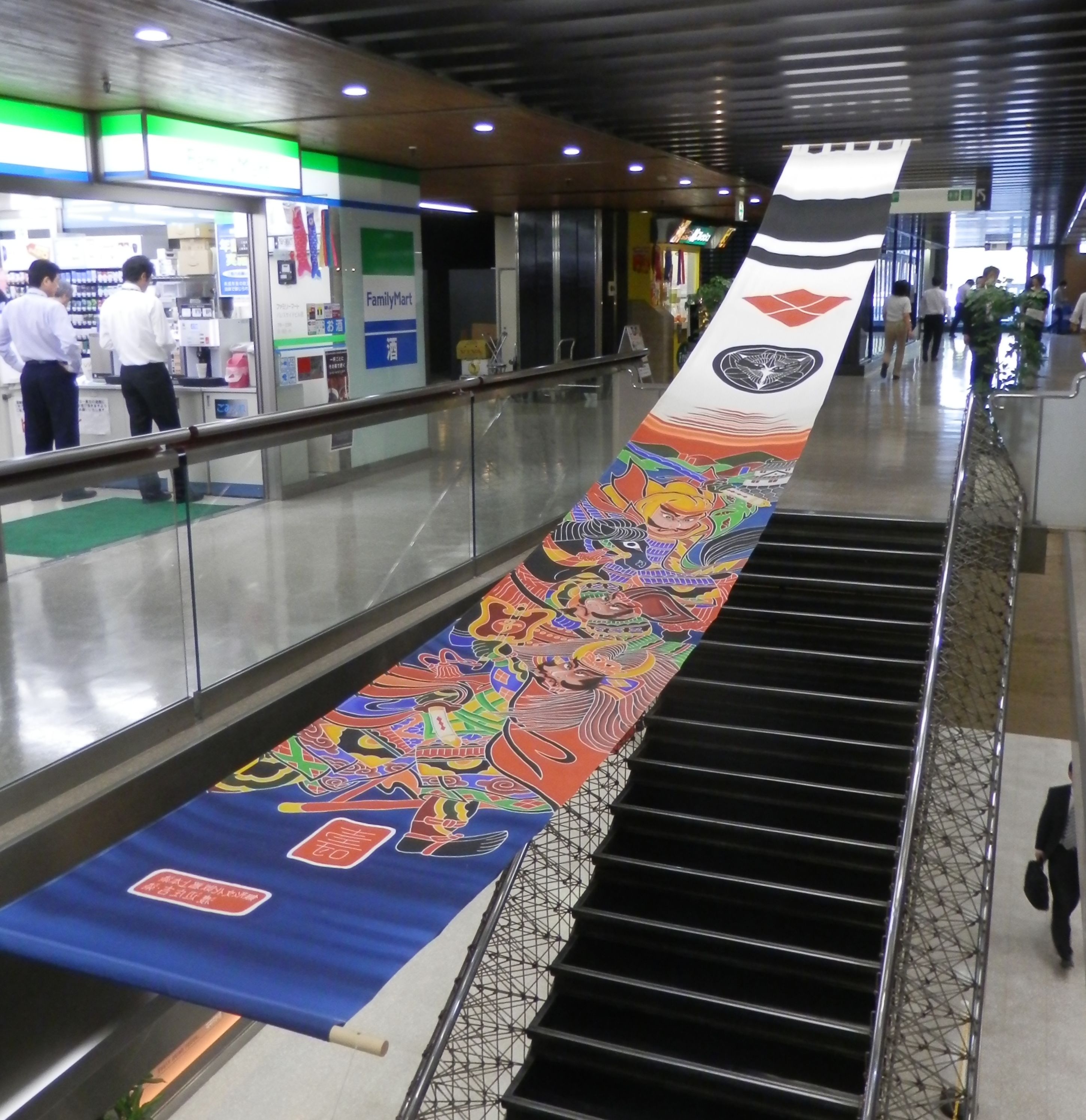
From the first-floor railings and ceiling hang streamers and black, red and blue carp, swimming in the central atrium. On the wall, for the first time this year, are Fujin and Raijin (photo at left); above the east Dream Stairs a seven-meter musha-nobori hangs at a slant over people going up and down. The banner shows the Battle of Kawanakajima between Kenshin Uesugi and Shingen Takeda (photo at lower right). Small koinobori also appear at Meitankai shop entrances.
These carp and warrior banners were dyed by Shokichi Watanabe of the Watanabe dye house in Gujo Hachiman, Gifu, an intangible cultural property of the prefecture, in the Gujo honzome technique handed down for more than 400 years.
Patterns are hand-drawn in rice-paste resist; the cloth is dipped again and again in a vat of indigo, wood ash, lime and wheat bran, then rinsed in winter in the Yoshida River through the center of Gujo Hachiman. The deep color is the charm.
The display is due to run through Friday, May 2 (it would have gone to the 5th, but the building is generally closed over the holiday, so in practice it ends on the 2nd).
On May 1 and 2, the first 1,500 people who use Meitankai shops on B1 and the first floor are to receive Kintaro-ame in a koinobori pattern.