

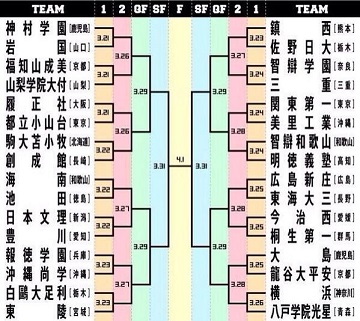
Tomorrow, the 21st, the 86th National High School Baseball Invitational Tournament (organized by The Mainichi Newspapers and the Japan High School Baseball Federation, supported by the Asahi Shimbun) opens. Pro and amateur fans alike thrill to the sound of the ball at Koshien. At Hanshin Koshien Stadium, where 32 schools will play for 12 days, practice sessions were held on the 17th and 18th. Tokyo metropolitan Oyamadai, in its first Senbatsu; Toryo of Kesennuma, Miyagi, hard hit by the Great East Japan Earthquake; Ikeda of Tokushima, back after 27 years; Oshima of Kagoshima, the 21st Century frame’s first Koshien team from the Amami Islands; and Riseisha of Osaka, in its fourth straight year, each had 30 minutes to feel the stage.
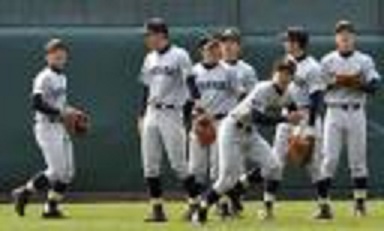
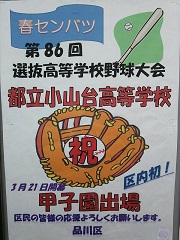
The Musashi-Koyama shopping street near Oyamadai (Koyama 3, Shinagawa Ward) has put up arcade signs and is buzzing over a metropolitan high school’s first Senbatsu (photo above: Oyamadai players at defensive practice at Koshien; photo below: a support poster on the local shopping street).
Oyamadai’s first-round game is on opening day, the 21st, against powerhouse Riseisha, east versus west. It is the first day of a three-day weekend — a match that has to be watched on television. Shinagawa Ward will also hold public viewings at two sites (the third-floor gym at Oyamadai High School and the third-floor lobby of the second ward-office building) and live-stream Oyamadai’s games on a large screen.
Oyamadai’s ace is captain Yusuke Ito (third year). Called a “carnivorous ace,” he is the key to a historic win for a famous academic metropolitan school. A newspaper report says his school bag holds a two-liter food container in place of a lunch box, packed at home with two cups of rice, an egg, and pork or chicken. He wants to put on more weight. The “carnivore” lunch is huge, but he is 178 centimeters and 71 kilograms. His fastball has been clocked at 140 km/h, and he also throws a curve, slider and splitter. A scout from a pro club has called him a talent with baseball sense and a future to watch. How he plays against an Osaka powerhouse on the Koshien stage will be worth seeing.
Of course one hopes they go all the way. The last public-school Senbatsu champion that comes to mind is Seihō of Nagasaki in 2009; including Ikeda, whose place in this tournament is already set, 37 public schools have won Senbatsu.
When the 32 captains gathered in Osaka for “Captain Talk Senbatsu 2014,” the No. 1 title favorite, with 11 votes, was Okinawa Shogaku — largely because it won last autumn’s Meiji Jingu tournament. That, too, will be worth watching.
In 1999 Okinawa Shogaku first took the long-sought Senbatsu championship flag back to Okinawa. The Mainichi Newspapers flew a “championship extra” from Fukuoka Airport to Naha Airport on a scheduled flight. Extras are free, so the cost per copy was probably the highest of any extra ever.