

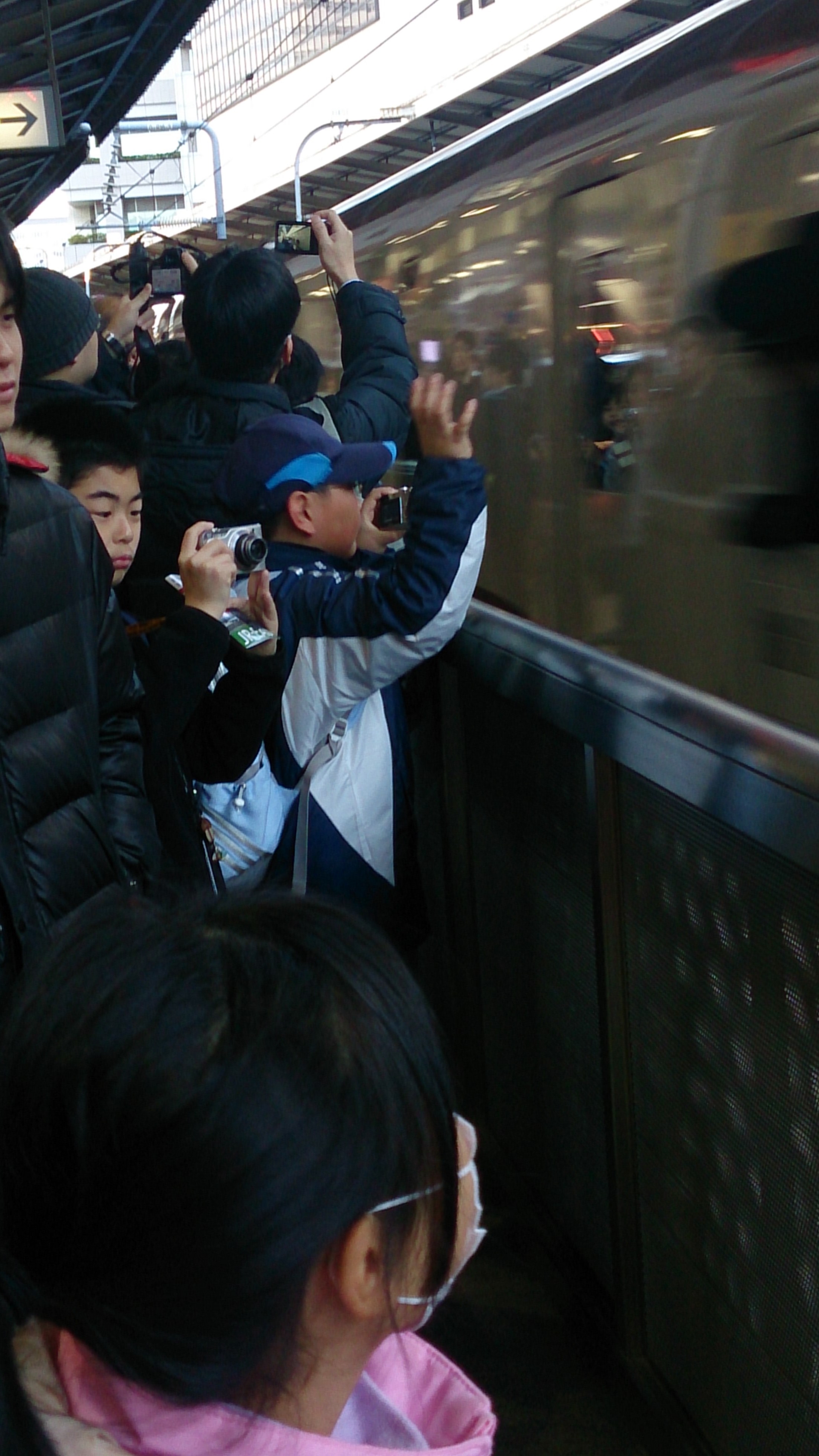
Newspapers and television reported that JR East’s new E7-series shinkansen, developed for next spring’s extension of the Hokuriku Shinkansen to Kanazawa, began commercial service between Tokyo and Nagano on March 15. I happened to see it at Tokyo Station that morning. I am no railfan, but the unusual crowd of camera-toting boys on the platform (photos at lower right) pulled me in, and I found myself shooting too.
As in the photo above, the vivid blue of the face and the well-defined nose line left an impression
.
The first up train was Asama 504, leaving Nagano at 6:42 a.m. for Tokyo; down trains began with Asama 505 at 7:24 a.m. for Nagano. What I saw was the second down train, Asama 509, leaving Tokyo at 8:36 a.m. for Nagano. Even so, fans packed the platform and cameras clicked — the first train must have been quite a scene.
The E7 was jointly developed by JR East and JR West. It is a 12-car set, four cars longer than the Nagano Shinkansen E2. Besides ordinary and Green cars, the Nagano-end lead car has 18 Gran Class seats.
Gran Class is JR East’s special car: more space per passenger than Green Car, with service on a par with the old first class or airline first class. It was introduced in March 2011 on the Tohoku Shinkansen E5 Hayabusa between Tokyo and Shin-Aomori, and has since been rolled out on E5 trains including the Nagano Shinkansen.
The Gran Class seats on this Nagano Shinkansen E7 were apparently developed by Toyota Boshoku, which also makes Lexus car seats. The shape is said to support the whole body in balance, whatever the passenger’s build or posture, for long-distance comfort. I would like to try it once.
Three E7 sets have been put into service first. For now they will run seven round trips a day; from April 19 another set will be added, making 11. After that, sets will replace the present E2 at a pace of about one a month.
Tickets for a trip on a train like this can be reserved and bought at Mainichi Shimbun Travel on B1 of Palaceside Building.