

On the 18th–20th day of the first month of Meireki 3 (1657) by the lunar calendar — March 2–4 by today’s calendar — the Great Meireki Fire burned about 60 percent of Edo, including the area around Edo Castle near Takebashi. Ekō-in Temple (2-8-10 Ryogoku, Sumida Ward) was founded to memorialize the victims, said to number from tens of thousands to more than 100,000 (photo above). (Minami-Senju Ekō-in in Arakawa Ward was once a branch of the Ryogoku temple but is now independent.)
Ekō-in’s website (http://ekoin.or.jp/) says: “Many who died in the disaster could not be identified and had no kin. Shogun Ietsuna granted land on the east bank of the Sumida River — the temple’s present site — so that these unclaimed dead could be buried with care. A mound called ‘Man’nin-zuka’ (the mound of ten thousand) was raised, and Jun’yo Shōnin, the 23rd head of Zōjō-ji, was ordered to hold a great service for the unknown dead. A hall for the nembutsu was built at that time; that
was the beginning of Ekō-in’s history.”
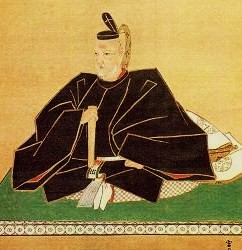
There is another account of how it began. “The Great Meireki Fire” (Takashi Kuroki, Kodansha Gendai Shinsho, 1977) attributes the idea to Masayuki Hoshina (photo at right). Hoshina was a half-brother of the third shogun, Iemitsu, and as counselor (taisei-sanyo) to the fourth shogun, Ietsuna, he carried great weight in the bakufu. He was also founder of the Aizu Matsudaira house (the family took the Matsudaira name in his son Masayasu’s time) and was known as the Aizu shōshō. (Some texts call him “tairō,” but as a shinpan he was not a formal tairō.) Returning from a visit to Zōjō-ji as the shogun’s deputy, he saw piled burned bodies, hurried back to the
castle, and proposed to tairō Naotaka Ii and the rōjū that the dead be gathered and buried in one place — the site of today’s Ekō-in. The Sumida Ward Tourism Association website likewise writes: “Aizu shōshō Masayuki Hoshina, guardian of the shogun, who had seen the carnage, ordered a common burial… a plot 60 ken square (about 3,600 tsubo) was granted, and the dead were buried without distinction of rank.” (Hoshina was a remarkable figure of the early Edo period; I hope to write about him in more detail when the chance comes.)
Whatever the fine points, Ekō-in became a place to hold services for people of every rank and every sect — hence the name “Shoshuzan Ekō-in” (as a sect it is Jōdo). And so, the temple’s website says, “This origin — memorializing the fire’s victims — is the temple’s guiding idea, kept to this day: the Buddha’s compassion for all living
things, whether human or animal, whether they have kin or none.”
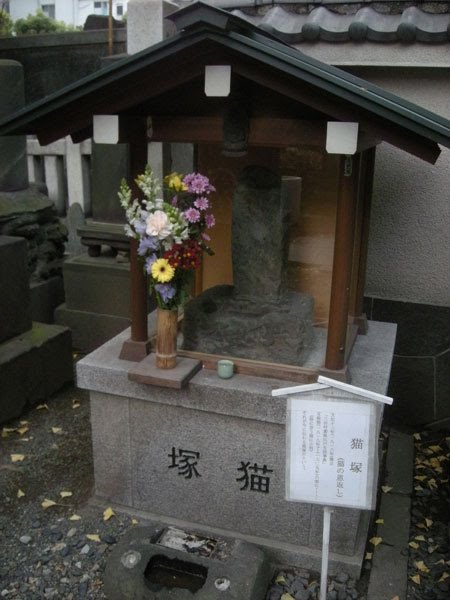
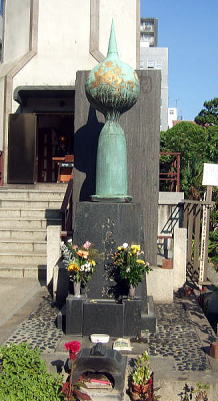
As that suggests, the grounds hold many memorials for animals: the Neko-zuka, or Cat Mound (1816, Bunka 13), known for a legend of a cat’s gratitude (photo at upper left); the Kara-inu Hachi-no-tsuka (1866, Keio 2); a fur-seal memorial (1926, Taisho 15); a dog-and-cat memorial raised by the Gidayu Association; and a small-bird memorial by the bird-and-beast dealers’ cooperative (photo at lower left).