

A subway ride from Takebashi brings you to redevelopment in Tokyo's Nihonbashi Muromachi East district—we reported that on February 26—but did you know a "wandering shrine" stands here?
It is Fukutoku Shrine. In the Edo period it was one of the few shrines licensed to sell tomikuji (early lottery tickets); many people come to pray for a winning ticket, so in those circles it is quite well known.
Today's site faces Mitsui Nihonbashi Tower on Chuo-dori, in the row north of "COREDO Muromachi"
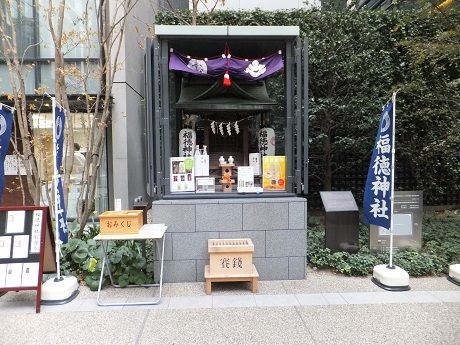
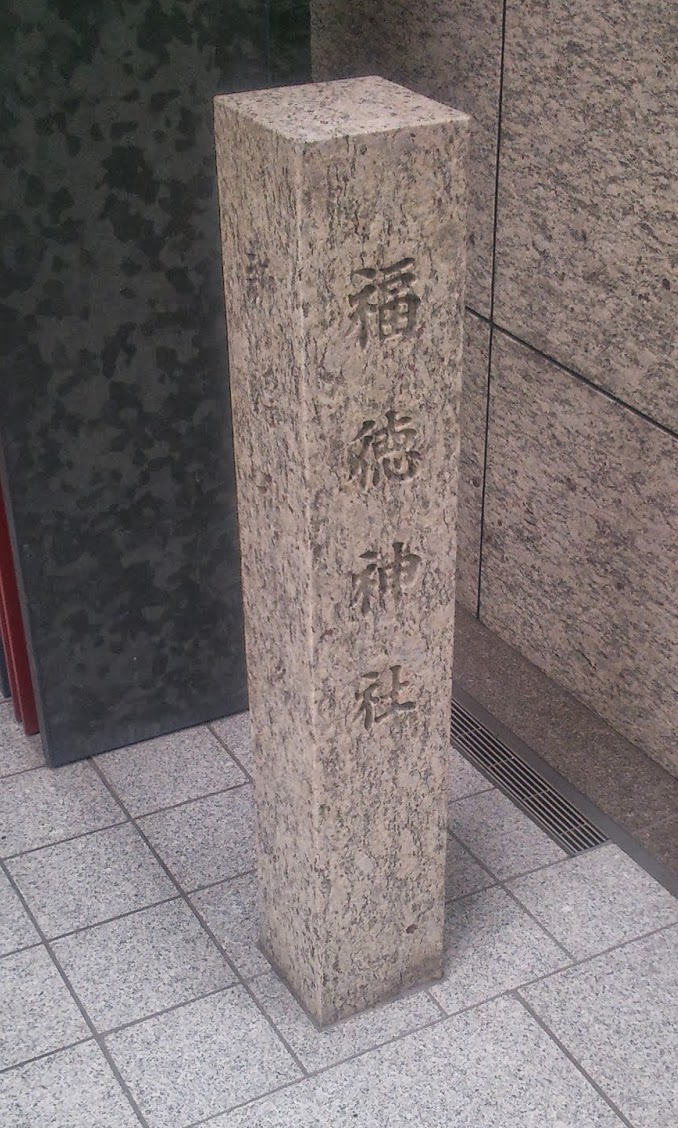
behind "YUITO" (Nihonbashi Muromachi Nomura Building). From Chuo-dori, enter between YUITO and YUITO Annex (Ukiyo-koji Senbikiya Building). As in the upper-right photo, beside the two-story shrine office (left) sits something like a tiny kiosk; a small hall is visible inside. On Chuo-dori there is also a stone pillar under one meter=lower-right photo.
The founding date is unknown, but it is said that in the age of Emperor Seiwa (Heian period) the shrine already stood in today's Nihonbashi area, enshrined as the Inari of Fukutoku Village
—and that the shrine name was taken from the place. When the second shogun, Tokugawa Hidetada, visited in the Edo period, buds had sprouted on a kunugi-bark torii, and the shrine gained the alias "Mebuki Inari."
It later burned in the Meireki Great Fire, which this blog has mentioned more than once, but the gravest crisis came with the Tempo Reforms (1830s–40s). Kabuki was suppressed then; Fukutoku Shrine, perhaps because of its lottery license, was doing rather well. It was said to be "too lavish" and was briefly abolished. After Elder Mizuno Tadakuni, who led the reforms, fell from power, parishioners petitioned the magistrate's office and the shrine was restored.
From the Meiji era on it also suffered the Great Kanto Earthquake and air raids. It overcame those hardships and was rebuilt each time, but perhaps because of its downtown site the sacred grove shrank after the war, and in 1973 redevelopment took the grounds—only the hall was moved to a rooftop. When that building was demolished, the hall was placed in a corner of a nearby izakaya in 2006; local momentum for rebuilding grew, and in 2011 it took its present form. In this redevelopment the tower parking opposite the shrine office has been taken down, and a new hall will be completed in October. That, we are told, is Mitsui Fudosan's wish to redevelop with a shrine that can serve as a community core. The grounds will grow from 40 square meters to 500, and the sacred grove will return (the top photo is a completion image).
Even in the postwar years the "wandering shrine" moved three times; a restless history is at last coming to a close.