

Continuing the "Meireki Great Fire" that on old-calendar Jan 18–20, 1657 (Mar 2–4 today) burned ~60% of Edo's urban area, including around Edo Castle and Takebashi.
A personal site covers this fire in detail (http://www.ne.jp/asahi/woodsorrel/kodai/edo/meireki.html)—impressive work. I'll introduce its Asakusa section. The kana-zoshi Musashi Abumi (1661; author Arai Ryoi, said to be a ronin who later took vows) appears in the Central Disaster Management Council report "1657 Meireki Edo Great Fire" (Mar 2004). It says Asakusa Gate stayed closed and people burned; illustrations included. Honmyoji's site (fire origin) quotes Musashi Abumi: rumor that prisoners escaped from Denmacho made the sole escape route close; people scaled gates and walls, but moats filled with crushed bodies; fire died ~4 a.m. next day; by dawn 25,000 corpses lay in the area =photo upper=.
The personal site cites "Ishide Kansuke's Report" (1725): over a hundred freed prisoners evacuated to Asakusa and all returned. The author concludes the closed-gate mass-casualty theory is Musashi Abumi's invention.
The site Bushoo Japan, calling itself "Japan's first history/Sengoku portal," also mentions prisoners (http://bushoojapan.com/tomorrow/2014/01/17/12860).
What's interesting: until Meireki, no rule existed for prisoners in emergencies. Troubled Denmacho jail magistrate (warden) Ishide Yoshifusa (hereditary name Ishide Tatewaki) bravely released prisoners at risk of punishment. "Emergency release—but come back! Escape and I'll hunt you to hell's end! Your families too—remember!" (paraphrase)—harsh terms, yet even death-row inmates wept with joy... After the fire, prisoners returned in line as promised. Yoshifusa said: "You kept your word—even as prisoners, well done. I'll ask the authorities to reduce your sentences"—approved by shogunate elders; sentences including capital crimes were reduced. This "emergency temporary release" became custom, carried into Meiji prison law and today's Correctional Services Act
—also used in the Great Kanto Earthquake and wartime air raids...
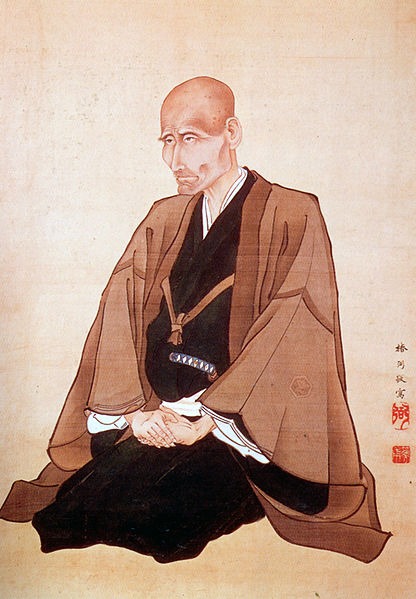
Incidentally, late-Edo rangaku scholar Takano Choei =photo left=, imprisoned in "Bansha no goku," was temporarily released in 1844 (Koka 1) when Kodemmacho prison burned; he fled, was recaptured in 1850 (Kaei 3), and died from beating—or resisted to suicide (the fire on escape is also said arson he instigated).
Small, seemingly random events connect across time—that's why history fascinates.