

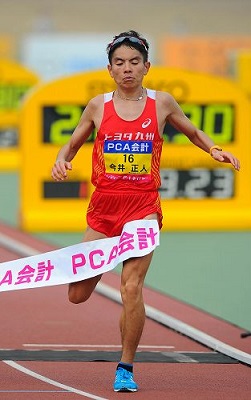
Last Sunday was the Beppu-Oita Mainichi Marathon. Dense fog in Beppu and Oita cities gave a unique race atmosphere. A record 3,213 runners competed. After 34 km, Abraham Kiprotich (Uganda) broke from a pack of four and won in 2:09:23. Imai Masato (Toyota Kyushu) =photo upper right= chased boldly late but missed by 7 seconds—2:09:30 for 2nd, a PB and first sub-2:10. 3rd: amateur Shiraishi Kenichi (Asahi Kasei) in 2:10:36.
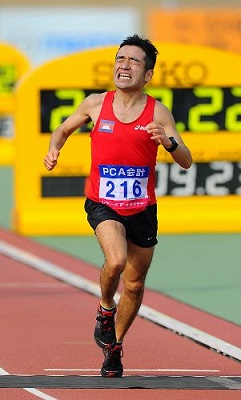
Cambodian talent Neko Hiroshi, back after two years as a general entrant, =photo lower right= finished 79th in 2:33:23. Mainichi reported he missed his target PB, saying "That's not purr-fect."
The Beppu-Oita Mainichi Marathon, first Sunday each February, joins Fukuoka International (early December), Tokyo Marathon (late February), and Lake Biwa Mainichi (first Sunday in March) as Japan's four majors. Proudly, Mainichi sponsors two of four. "Biwa-ko" since 1946 is Japan's oldest; Beppu-Oita since 1952.
Palaceside Building's 1F "Run Pit" delights citizen runners. More use it and nearby facilities for Imperial Palace runs. The marathon boom's downside: elite races are hard to enter.
This month's Tokyo Marathon on the 23rd draws 36,000 runners, 10,000+ volunteers, and 1.72 million spectators. Charity slots exist, but general entry exceeds 10:1 odds. Qualification is finishing under 6:40—low bar, but fewer than 1 in 10 get in. Statistically, once a decade.
Other popular races see multiples of applicants; first-come races fill in minutes. Runners want a "stage in the sun," but securing slots is stressful.
Yet many know Beppu-Oita Mainichi: with certain credentials, entry is guaranteed. Qualifications eased recently. The 63rd required (simply) age 20+ on race day and a full marathon under 3:30 gross since Jan 1, 2012. Meet that, enter Category 3—you're in. Fee ¥8,000; tours with hotels and transport make it affordable.
Next year's requirements come in late August—may change. If you've run under 3:30, try next year.