
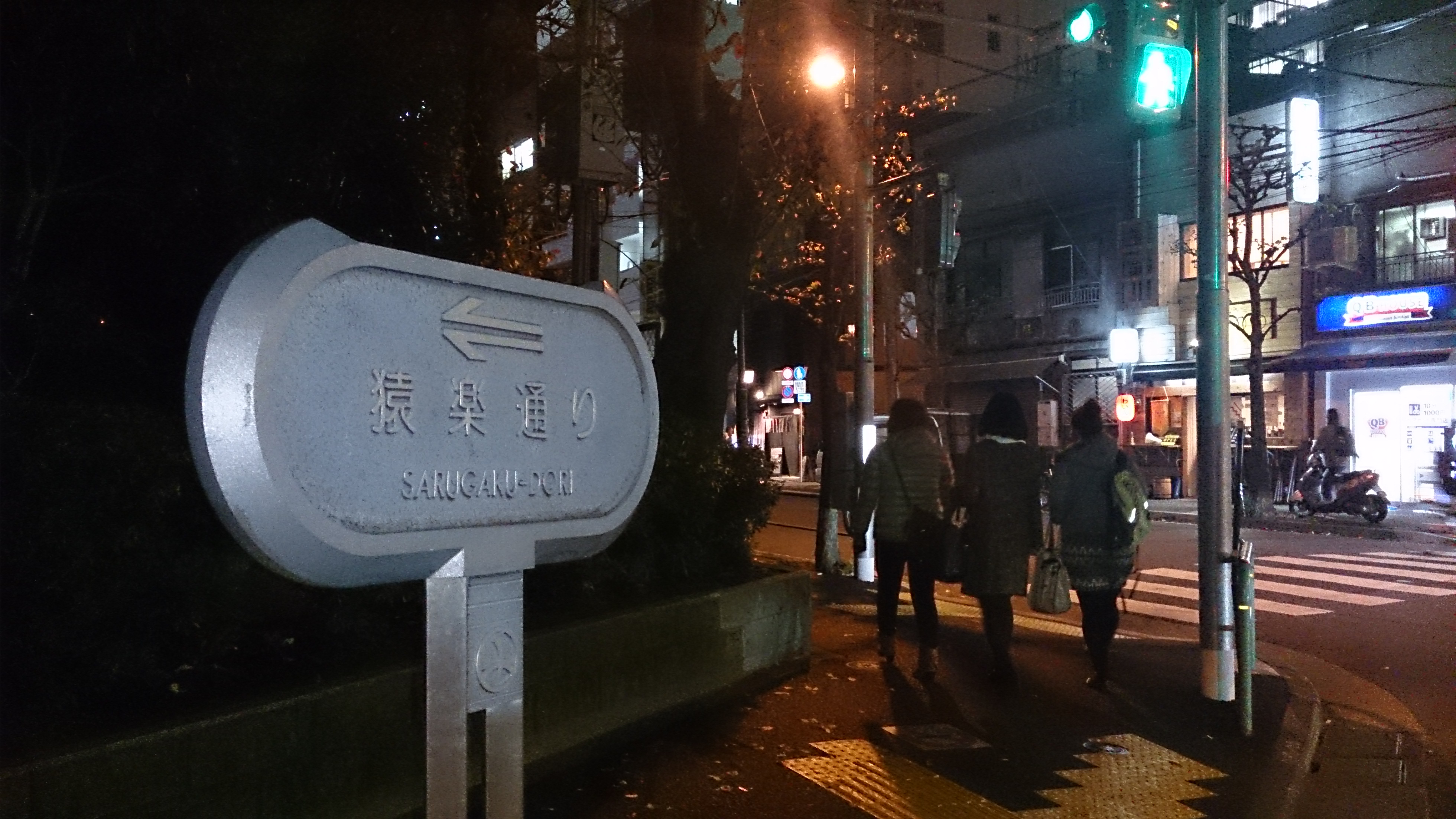
Strolling from Palaceside Building along Hakusan-dori toward Jimbocho. Cross the intersection and enter slightly ahead to the right—you reach Chiyoda Ward Ochanomizu Elementary and Kindergarten. Northwest from here, a long strip roughly 200 m east-west and 600 m north-south is "Sarugakucho." The fence at Ochanomizu Elementary bears the address "Sarugakucho 1-1." Sarugakucho-dori runs through the center like a spine=photo lower right=.
Northwest of Sarugakucho, the trapezoidal area about 500 m north-south and east-west directly south of JR Suidobashi Station is "Misakicho."
In both towns, a heated debate over town names is brewing—whether to add the prefix "Kanda."
It began in 2004 when petitions to restore "Kanda" in both towns, with some 1,100 signatures, were submitted to the ward
—but some 1,500 opposition signatures followed, splitting opinion evenly. A 2012 ward survey showed 57% favor or lean favor, 42% oppose or lean oppose—little gap.
Historically, Meiji-era names were "Misakicho" and "Sarugakucho." After Kanda and Kojimachi wards merged into Chiyoda in 1947 (Showa 22), former Kanda towns gained the "Kanda" prefix—"Kanda Misakicho" and "Kanda Sarugakucho." In 1962, with the address-display law for efficient mail delivery, the ward dropped "Kanda" prefixes; Misakicho in 1967, Sarugakucho in 1969—status quo since.
Chiyoda Ward seems to cherish town names as culture, even maintaining a "Town Name Origin Plates" page listing 110 names (http://www.city.chiyoda.lg.jp/koho/bunka/bunka/chome/yurai/index.html)—perhaps restoration reflects the ward's true wish.
Per origin notes, Misakicho was called Misaki Village until the Edo shogunate; the name came from land at the tip of shallow Hibiya inlet. Reclaimed wetlands became samurai quarters; in 1872 (Meiji 5) this area became Misakicho. "Kanda Misakicho" lasted only ~20 years, 1947–67.
Sarugakucho was samurai residences in Edo; present Kinka-dori was omote Sarugakucho, Sarugakucho-dori ura Sarugakucho. Around Keicho, Noh master Kanze Dayu had residences from Kanda Jimbocho to Nishi-Kanda—the name's origin. Postwar "Kanda" prefix lasted ~22 years.
Even after dropping "Kanda" in the 1960s, 26 towns kept it—e.g. Kaji-cho 1–2 became "Kaji-cho" but 3-chome remains "Kanda Kaji-cho." Pro-restoration: "Kanda is a valuable brand; revive history to revitalize the area." Opponents note samurai origins: "'Kanda' means fields for shrine offerings—why attach a mismatched prefix?" Others cite confusion with Shibuya Sarugakucho or old Kanagawa Misakicho; businesses warn of reprinting costs if addresses change.
After all, Chiyoda sits at the very center of Tokyo, Japan's hub since Edo. Each town name "carries tradition and culture nurtured through history since the shogunate" (ward website). Longtime residents and newcomers live and work there—split opinions are natural.
Last November the ward's formal "Residential Display Council" met for the first time in 34 years, hearing both sides on prefix restoration. Unlike forced votes on the state secrets law, convergence will take time.