

Much is scheduled for 2014, but one concern for Palaceside Building tenants may be the end of Windows XP support. XP PCs are quite underpowered now, yet some still use them.
Microsoft Japan recently warned on its official blog that
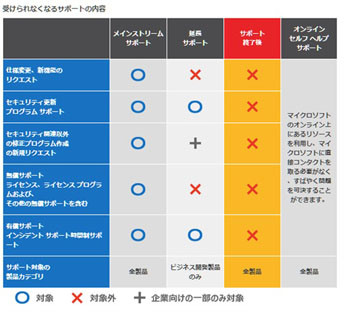
Windows XP and Microsoft Office 2003 will reach end of support "100 days from Dec 30, 2013"=chart. XP and Office 2003 support ends April 9, 2014 Japan time.
The Official Microsoft Japan Blog article explains via 12 FAQs what end of support means, why it happens, and risks of continued use—questions like "Can I still use XP PCs?" and "Am I safe offline?" Microsoft cites mainly security; XP had many users over a long period, making vulnerabilities a problem.
Incidentally, Microsoft developed MS-BASIC in 1975. Toshiba announced the first Japanese word processor JW-10 in 1978—8-inch floppy era, priced 6.3 million yen. A brief timeline:
1979: NEC launches PC-8001—first "personal computer" in Japan
1980: Fujitsu OASYS100 (24-dot printer, 14" CRT, 8" FDD, 3,200,000 yen)
1981: IBM PC in America (OS: MS-DOS 1.0 from Bill Gates)
1982: NEC PC-9801 (298,000 yen)
1983: Nintendo Family Computer (14,800 yen)
1984: MS-DOS 3.0 announced
1985: Ichitaro for PC-9801 (JustSystem, 58,000 yen)
1985: MS-DOS 3.2 announced
1989: Toshiba first Dynabook (first PC/AT-compatible notebook in Japan, 198,000 yen)
1990: IBM PC-DOS 4.0/V (DOS/V) announced
1991: Microsoft Windows 3.0
1993: Microsoft Windows 3.1
1994: Netscape developed by Mosaic team (Internet browser)
1995: Windows 95
1998: Windows 98
2000: Windows 2000
2000: Windows Me
2001: Windows XP
2004: IBM exits PC business
2009: Windows 7
2012: Windows 8
Laid out like this, PC and OS evolution is astonishing. I started with the 1989 Dynabook—nearly a quarter-century. Before that, Jobs-led Apple shipped Apple II in 1977, beating IBM "Big Blue." Microsoft's fierce court battles with Apple over Windows remain memorable.
As trivia, HAL the AI in "2001: A Space Odyssey" (1968, Clarke/Kubrick)—shift each letter of HAL one place and you get IBM.