

After work I stopped at Ginza Lion Shinjuku Center Building — a beer hall that also has a branch at Palaceside Building — for dark beer. The ceiling is strewn with stars and constellations, making the stout taste even cleaner. I botched a smartphone photo, so the main photo is from the shop’s website. Palaceside B1 “Beer Dining Lion” has an ordinary ceiling, but Ginza Lion and affiliated stores nationwide often feature starry night skies; the Aoyama-itchome branch display is especially impressive.
As for the real night sky, the National Astronomical Observatory’s site now has a Comet ISON feature, and a few more people seem to be looking up on winter mornings.
NASA says Comet ISON was discovered in September 2012 by two scientists in the International Scientific Optical Network (ISON), about 940 million km from Earth — already racing toward the sun at 77,000 km/h, passing perihelion closest to the sun on November 29. Yes — tomorrow morning it approaches the sun most closely.
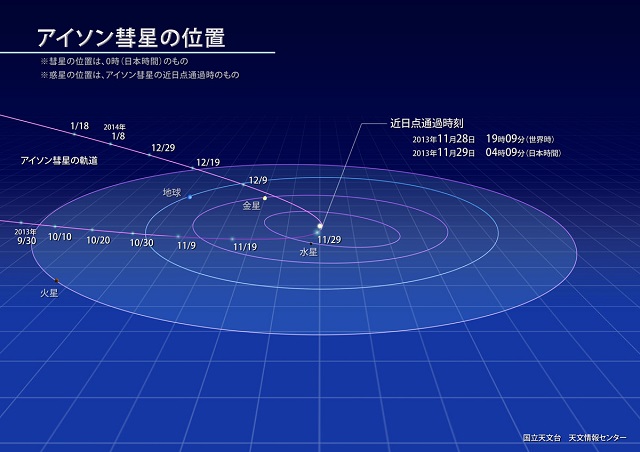
With a nucleus 4.8 km across — large for a comet — ISON may become a “great comet” trailing a huge tail after solar approach. The observatory warns that from about November 25 to December 2, ISON and the sun will appear less than 10 degrees apart; use binoculars or telescopes with care not to look at the sun by mistake. From around December 4 observation should become easier.
There is even a “Let’s ‘eye’ ISON in the eastern sky before dawn” campaign. Digital cameras, binoculars — early December is the best window. Eastern sky before dawn — what shall we wish for?
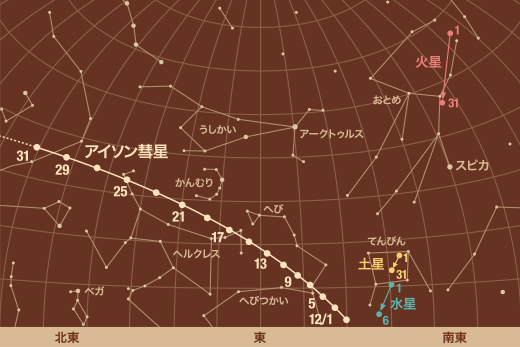
Sunrise in Tokyo on December 5 is 6:35 a.m.