
The other day I introduced Kanda Sewer on this blog as a birthplace of modern sewerage in our country — but look closer and Yokohama can also claim to be Japan’s first.
Yokohama City’s Environment Creation Bureau has a page called “The Beginning of Sewerage” describing Meiji-era development.
It proudly lists, as “first introduced in Yokohama in Japan,” parks, newspapers, horse racing, and infrastructure technologies such as railways, telegraph, water supply and gas. On sewers it explains that foreign residents in the settlement, having watched pollution spread with industrial growth in their home countries, keenly felt the importance of urban infrastructure.
Specifically, based on the “Yokohama Settlement Memorandum” signed in November 1864 (Genji 1) between consuls of various nations and the shogunate, Richard Henry Brunton — one of the Meiji government’s first foreign hires, British — began laying earthenware sewer pipes in 1869 (Meiji 2) and completed the work in 1871 — quite early. Capacity could not keep up and blockages were constant; Kanagawa Prefecture began survey and planning for reconstruction in 1880, with Goyogakari Mita Zenitaro in charge from 1881 to 1887, laying about 4 km of brick egg-shaped pipe (inner diameter 3×4.6 m) and 12.6 km of earthenware pipe (1×1.6 m). Kanda Sewer was built in 1884–85, so Yokohama is indeed earlier.
Incidentally, like Kanda Sewer, this system used the inverted egg shape devised by the Englishman J. Phillips — rational structure that maintains velocity when flow is low and keeps debris from accumulating.
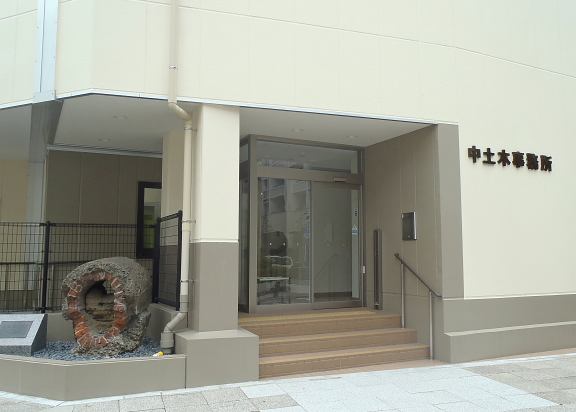
In 1981 (Showa 56), during construction of Kaiko Plaza next to the Yokohama Archives of History in Yamashita-cho, excavated egg-shaped sewer pipes were preserved in place beside the basement viewing room (Yokohama City Naka Ward website); another is displayed in front of the Chudoboku Office =photos upper and upper left, with a memorial stone right beside it. Designated a national tangible cultural property in 1998 as the “Former Yokohama Settlement Brick Sewer Manhole.”
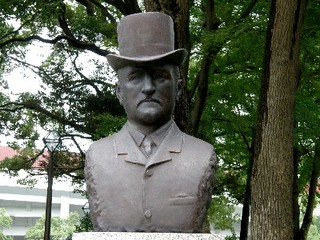
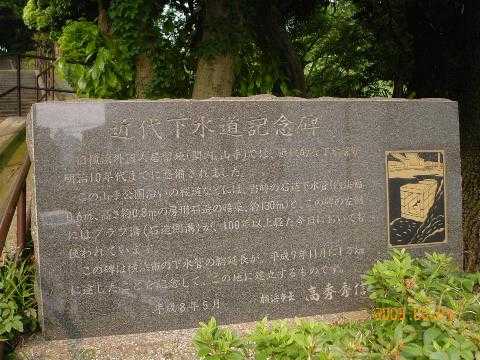
Also, in a corner of Yokohama Park where Yokohama Stadium stands, there is a bust of Brunton =photo upper right. Yokohama Park itself was designed and built by Brunton (1871–72). Near Ferris Girls’ School, Yamate Park has a “Modern Sewer Memorial” =photo lower right; Yokohama City promotes “original sewer” citywide.
But — not because Palaceside Building is in Chiyoda Ward — “Yokohama = number one” does not quite sit right. The settlement was extraterritorial “foreign” territory; it was “returned” to the Japanese side only in 1899. So the birthplace of modern sewerage “in Japan” is Kanda, I would like to certify… though that may be a stretch? Yokohama’s designation is national; Kanda’s is metropolitan.
Wikipedia distinguishes Kanda as the “first modern sewer network to be developed” and Yokohama as “Japan’s first construction of a modern sewer network.” The Tokyo Metropolitan Bureau of Waterworks calls Kanda the “first modern sewer planned, designed and laid by Japanese hands”; the national cultural property database calls Yokohama the “first modern sewer remains under Japanese planning.”
Hmm — which is which? I am lost.