

The other day I introduced on this blog a photo exhibition at Jimbocho Gallery showing nothing but the interiors of sewers. Did you know that not far away lies a place that can be called the birthplace of modern sewerage in our country?
It is on the left side of Tamachi-dori, less than 50 meters from Kanda Station’s west exit toward Yasukuni-dori — not far from Palaceside Building either. Ni
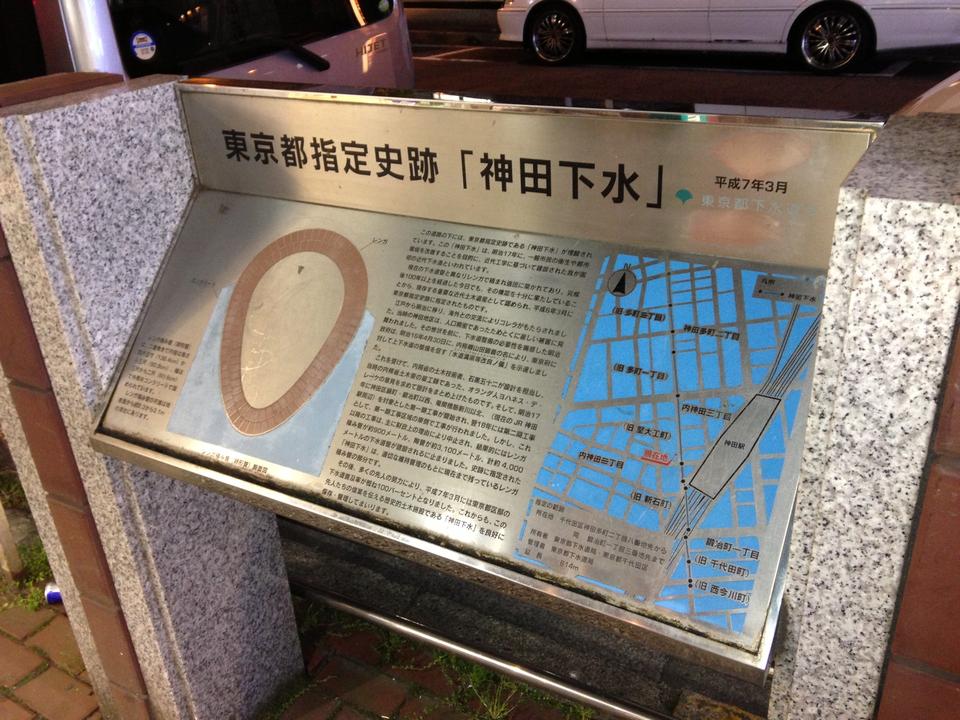
On the sidewalk in front of Nishizawa Pharmacy stands what might be called a monument or guideboard for “Kanda Sewer” =photo lower right.
According to sites of the Tokyo Metropolitan Bureau of Waterworks, Chiyoda Ward Tourism Association, Japan Society of Civil Engineers and others, as the era shifted from Edo to Meiji, cholera brought by exchange with overseas spread repeatedly across Japan. In 1882 (Meiji 15) alone, deaths nationwide reached 30,000, with more than 5,000 in Tokyo Prefecture; the government recognized the need to improve sanitary facilities including water supply and sewerage. Specifically, after the Tokyo Prefecture received the 1883 directive “On Improvement of Water Channels and the Like,” Interior Ministry engineer Ishiguro Goju, under Dutch government-hired engineer Johannes de Rijke, is said to have laid sewers in 1884–85. Kanda at the time was chosen because its dense population made infection easy to spread.
Incidentally, it was then called a “perpetual drain,” with pipe cross-sections 610–910 mm wide and 910–1,360 mm high — an inverted egg shape devised in 1846 by the Englishman J. Phillips, a rational structure that maintains flow velocity even when wastewater volume is low and keeps debris from accumulating.
Work stopped after two years for fiscal reasons. What was built amounted to 900 meters of brick pipe, 3,100 meters of earthenware pipe, about 4,000 meters in all — yet it has endured loads far beyond design assumptions: the Great Kanto Earthquake, World War II, and surging road traffic. About 815 meters around Kanda Station where the monument stands remain in service today. Of that, 614 meters of brick construction were designated a historic site by the metropolitan board of education in 1994.