

Suddenly—Neapolitan. Yes, spaghetti. Many places near Palaceside Building serve delicious pasta, but this story is Yokohama.
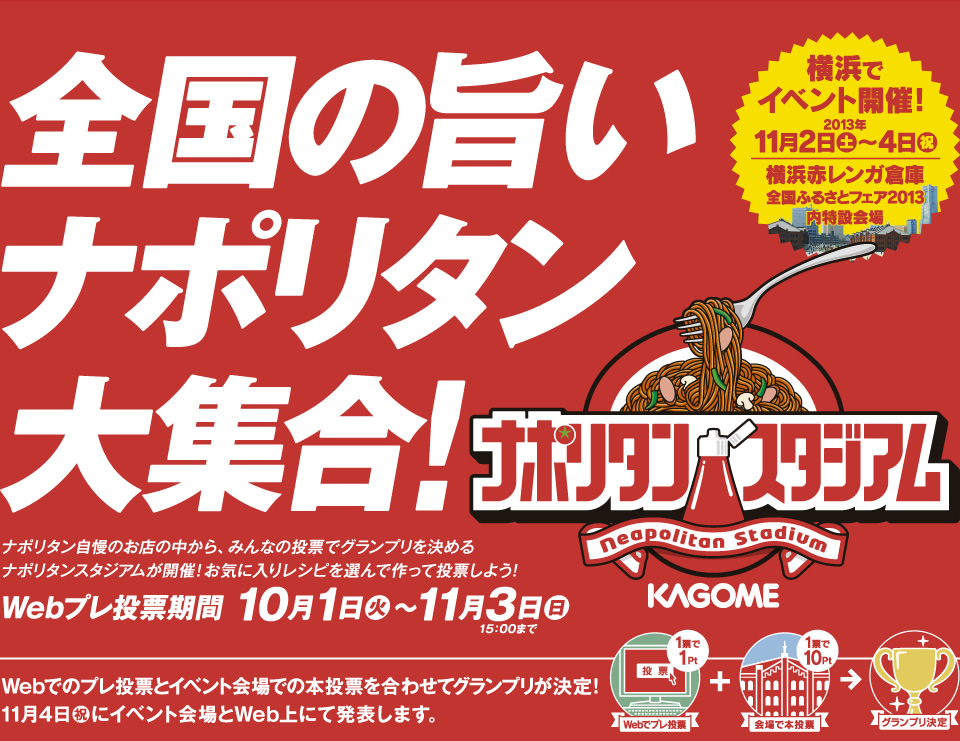
Right now the "Neapolitan Stadium" project is deciding Japan's best Neapolitan—compare local versions in Yokohama, Nagoya, Hiroshima, even Shanghai among 16 shops. Hosted by Kagome, known for ketchup; pre-voting continues on the Web (http://kagome-cp.jp/naposta/). Finals November 2–4 at Yokohama Red Brick Warehouse event plaza: eat and vote (2-ticket book 1,000 yen for all 16 shops, single plate 550 yen), combined with Web voting for the champion. (Part of "National Hometown Fair 2013.")=photo left from Kagome's site.
Hmm, why Yokohama? Because Yokohama is considered the birthplace of Neapolitan. Wait—not Naples in Italy?
On February 26, 2009, Yokohama Customs appended "Spaghetti Imports" mini-knowledge to a document marking 150 years since Yokohama Port opened. Pasta may have started as Arab preserved food, reached Sicily under Arab rule in the 12th century, spread to Italy as the Mediterranean climate suited drying; tomatoes from the Americas reached Europe in the 16th century, tomato sauce by the 17th.
That is prehistory. Before the birth story: Italy has spaghetti Napolitana—how does it differ from Japan's Neapolitan?
Neapolitan uses ketchup with onion, bell pepper, bacon, sausage, etc. Napolitana uses tomato sauce, paste, canned tomatoes, puree, concentrate, dried tomatoes—completely different. Ketchup is rarely used in Italian cooking; no dish called "Neapolitan" exists in Italy.
Birth story per Yokohama Customs: Hotel New Grand in Yamashita, Yokohama. After WWII requisition by GHQ, second head chef Shigeo Irie drew on GIs' ketchup spaghetti and created Neapolitan around 1955. Still popular at first-floor "The Cafe"=photo top. Imposing presence. The hotel also claims seafood doria and prune à la mode as house originals.
Legend sourced from fourth head chef Seiichi Takahashi's "Yokohama Style—It All Started Here" (Tokyo Shimbun); Ueno Rei's "Neapolitan" (Shogakukan Bunko) lists others: "Navy theory"—Japan sent a fleet to the Mediterranean in WWI and learned tomato pasta in Italy; comedian Roppa Furukawa's 1934 diary records Neapolitan at Mitsukoshi special dining room—the oldest known record, supporting a "Mitsukoshi origin" theory.
Either way, pasta spread widely in Japan after pasta machines imported from Italy in 1955—domestic production 3,770 tons that year per Yokohama Customs. Japan's unique flavors like Neapolitan surely helped expand consumption.