

I watched it and cried.
It is a talked-about film, so even on a Sunday evening the Kawasaki theater was full of families, groups of young people, and couples. The beauty of the images was Ghibli, as you would expect.
It is not only Miyazaki Hayao’s last work; smoking scenes drew complaints from an anti-smoking society, and in Korea it was criticized as a film that glorifies prewar Japanese invasion — it made news and controversy. Film reviews in papers were unusually tart for Ghibli: “Jiro’s conflict over ultimately aiding the war is barely drawn; if you expect civilization critique or a ‘social picture,’ you are left empty-handed” (Mainichi, July 19 evening).
The official site’s “planning notes” say:
“A friendship across time between Jiro Horikoshi, designer of the Zero, and his Italian senior Gianni Caproni, men of the same will. The two who, past many setbacks, give their strength to the dream of boyhood… This film does not mean to denounce war. Nor to stir Japanese youth with the Zero’s excellence. … I want to draw a man who went straight, faithful to his dream. Dreams hold madness; that poison must not be hidden. Yearning for what is too beautiful is also a trap of life. The price of leaning toward beauty is not small. … The title The Wind Rises comes from Hori Tatsuo’s novel of the same name. Hori translated a line of Paul Valéry as ‘The wind rises, we must try to live.’ The film mixes the real Horikoshi Jiro and the writer Hori Tatsuo, who lived in the same age, into one hero, ‘Jiro.’ On the warp of the birth of the Zero that later became myth, the weft of young engineer Jiro’s meeting and parting with the beautiful, ill-starred girl Nahoko, with Uncle Caproni adding color across time, it draws 1930s youth as complete fiction — an unusual work.” (as written)
I will not detail the story, but Jiro’s real wife lived out her years; Nahoko is fictional, likely modeled on Hori’s fiancée. In any case, I think it wants to say that wartime youth held a painful purity and an unmanageable anguish together… or that the pain makes the purity stand out… That depth makes it a film worthy of Miyazaki’s “fine ending.”
After the screening my elementary-school daughter asked, “Did Nahoko die?” When I said yes,
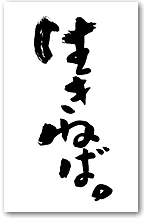
she teared up: “Poor her.” Passing the end lightly feels akin to “Ama-chan” not showing the tsunami’s misery in realistic images. Still, for the last ten-odd minutes I could not stop crying, and at the end I simply felt that Jiro’s “will to live” is the point.
The film’s catch copy = right. The official site says:
“This copy has a deep tie to Miyazaki’s representative work Nausicaä of the Valley of the Wind. … The words in the last panel of volume 7, the final volume of Nausicaä, are ‘We must live…’”