

Where are you from? That region has its dialect, of course, and like Takuboku’s “the hometown accent I miss / I go into the station crowd to hear it,” some of you may recall the speech of home.
It is not only because Aki-chan, the heavily accented heroine of “Ama-chan,” is popular, but the “hometown-appraisal dialect chart” by the knowledge site JapanKnowledge and Tokyo Woman’s Christian University’s Shinozaki seminar (http://ssl.japanknowledge.jp/hougen/) = photo above has become a small topic. (The weekly Economist published by the Mainichi also supplies content to this site.)
The chart tells your home prefecture from dialect questions alone. It was developed by eleven seminar students under Professor Shinozaki Koichi of Tokyo Woman’s Christian University. Professor Shinozaki, in a book co-written with the Mainichi,
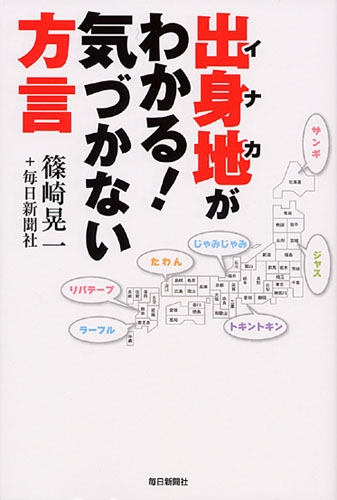
“Your Hometown Shows! Dialects You Do Not Notice” (2008, Mainichi, 945 yen) = photo right, also “compiled for the first time, from the latest surveys, the ‘unnoticed dialects’ that do not work in Tokyo and can embarrass people from the regions,” and it was well received.
Part 1, “What, this is dialect?” lists a Tokyo top ten of unnoticed dialects: people from Hokkaido say “sabio” for bandage, Kumamoto “riba-tape,” Saga “cut-ban”; “gabyo” is “kabyo” in eastern Japan and “oshi-pin” in the west; in Chubu and Kinki, milk in coffee is “fresh” — and so on. This chart is that material arranged for a net test.
I tried it. The result was the next prefecture. Only about fifteen kilometers away, though, so “pretty close” perhaps.
The seminar defines “hometown” as the place you lived in the language-forming years, about ages 3–4 to 13–14. If you moved often then, pinning a hometown can be hard, they say.