

Only a few days of August remain, and at dawn and dusk you can already spot a “little autumn” here and there. It would be nice if the heat eased as is, but the one-month outlook for Kanto-Koshin says temperatures through late September will run a bit above normal.
In the East Gardens of the Imperial Palace, mukuge (rose of Sharon) = photo above = and fuyo (cotton rose) = photo middle = now add color and calm. Mukuge is around Hyakunin-bansho and Obansho; fuyo is blooming between the pine lawn — closed until late September for turf recovery — and Hasuike-bori. Both flower from early summer into early autumn and look so alike you must look closely to tell them apart.
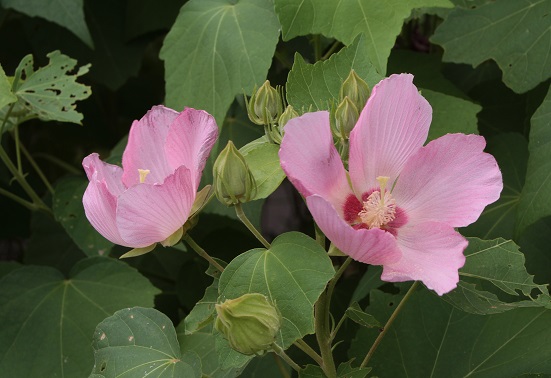
Mukuge (also hachisu) and fuyo belong to the mallow family with ornamental hibiscus — some 75 genera and 1,500 species, many with beautiful flowers. The family also includes edible okra and fiber plants such as cotton and kenaf. The aoi used in family crests (the Tokugawa triple hollyhock, Shimogamo’s futaba-aoi) is a different family: the leaf of Asarum caulescens in the birthwort family.
Mukuge is native to China — the characters 木槿 are the Chinese name — and is South Korea’s national flower. It seems to have reached Japan by the Manyo age; some say what was then called “asagao” was actually mukuge. Each bloom lives only a day: “a hibiscus dream of one morning,” they say — open at dawn, shut at night. That brevity and modesty may be why literature and the tea flower have long favored it.
Fuyo grows wild in Shikoku and Kyushu, in white and many pinks, a little larger than mukuge. People have likened a beauty to a “fuyo face.” It too is a one-day flower. The garden form suifuyo (drunken cotton rose) opens white in the morning, turns pink, and is red by evening — like a fair-skinned beauty flushing with wine, hence the name.