

For August 15 there are many television programs again this year. One was the drama “Hotaru no Haka” (Grave of the Fireflies) on BS Nittele on the night of the 11th. The source is Nosaka Akiyuki’s novel of the same name; this was a rebroadcast of the 2005 sixtieth-anniversary special that made news. After the Kobe air raid burns their house and they lose their mother, junior-high Seita takes four-year-old sister Setsuko to relatives, quarrels and leaves, and both die of malnutrition. The drama lights not only the brave siblings but the aunt (Matsushima Nanako) who had to be cold to them. The site calls it “a human drama of people tossed by war.” Nosaka wrote: “It is taken as a beautiful tale of sibling love, living and dying hard in wartime. But I actually survived, and I was not so kind a brother. In that age everyone found it hard to live. Men staked their lives; women were fighting too.”
Nosaka’s weekly Mainichi column “Nanakorobi Yaoki,” installment 133 (June 23, 2012), touches the story: “…in the dugout we spread a mat, laid my sister on a hanten, and I staggered looking only for food. … I wrote part of this in Grave of the Fireflies. Much fiction is mixed in. … Just this season, damp, heat, and above all hun
ger, we suffered in a hillside dugout. After sixty-seven years I am past eighty. I forget other things, but that deep dark weighs on me as if it were yesterday.”
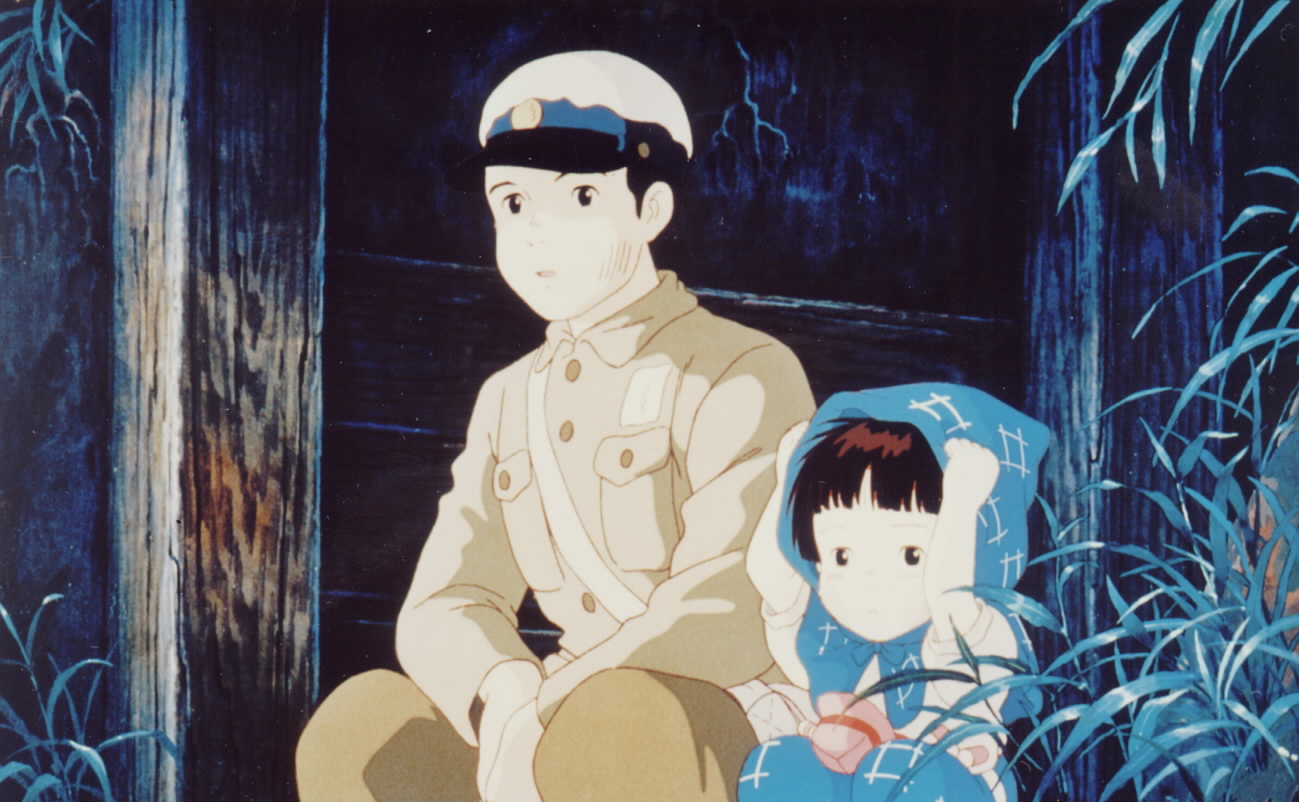
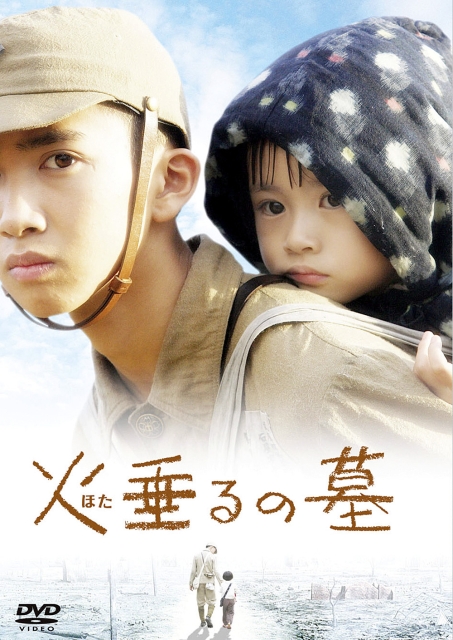
Studio Ghibli made an anime in 1988 (Takahata Isao) = photo left, and a live-action film (Hinadori Taro) opened in July 2008 = photos right and below.
When I first saw the anime, the siblings — especially little Setsuko — trying so hard to live
filled my chest, and the cruelty of being crushed by adults’ naked ego and calculation was painful to watch.
Takahata’s intent, though, was unexpected. In Animage (Tokuma Shoten), May 1988, he said:
“…(the two) built the joy of a household, a meeting of hearts — love, if you like — and in that measure Seita lived a very full life. … But he fails at ‘social life.’ … The adults around may have been cold. Yet Seita too does not seek ties; he throws away chance after chance. … Can we criticize that?”
He then pulls it to the present:
“Social life is all bother; if we can, we avoid company we cannot trust and shut ourselves in our own world — that is now. … We should feel Seita’s heart painfully well. … Their age had neighborhood associations, the Patriotic Women’s Association, the Industrial Patriotic Association, and of course the army — oppressive collectivism. … Seita frees himself from that. … If the age reversed again, could we keep from being swept by totalitarianism? Far from becoming Seita, might we denounce him even more than the widow? I am afraid.”
Ways of seeing differ. Takahata’s words make you think. A simple “it hurts to watch” may not be enough… That is why Grave of the Fireflies becomes drama and film again and again. I will reread and rewatch many times. Only — at what age to show a child… that I still worry about.