

After Hiroshima on August 6, tomorrow the 9th is Nagasaki’s atomic-bomb memorial day. Each year at this time newspapers and television run features on war and the bomb. Some criticize the seasonal (only-now) coverage, yet it has settled as “war journalism” that keeps a tragic history from fading.
This year the Tokyo Shimbun (August 1 evening edition) reported a story around Hiroshima’s Atomic Bomb Dome. In outline: (1) in the central cemetery of Brno, southeastern Czechia, stands a century-old gravestone shaped like a shrine torii = photo above, from the Czech news site Lidovky.cz; (2) it has recently been identified as the work of Czech architect Jan Letzel (also written Reczl, Letzel, Retzel); (3) Letzel designed the Hiroshima Prefectural Commercial Exhibition Hall that later became the Dome — a hidden tale of the Dome.
As the article says “recently,” a local art historian found this four years ago. Photos right and below are Lidovky.cz’s November 2009 report (http://www.lidovky.cz/v-brne-objevili-hrob-od-tvurce-atomoveho-domu-v-hirosime-p29-/zpravy-domov.aspx?c=A091116_080045_ln_domov_ter). I do not read Czech, but a machine translation suggests the design “resembles a traditional Japanese
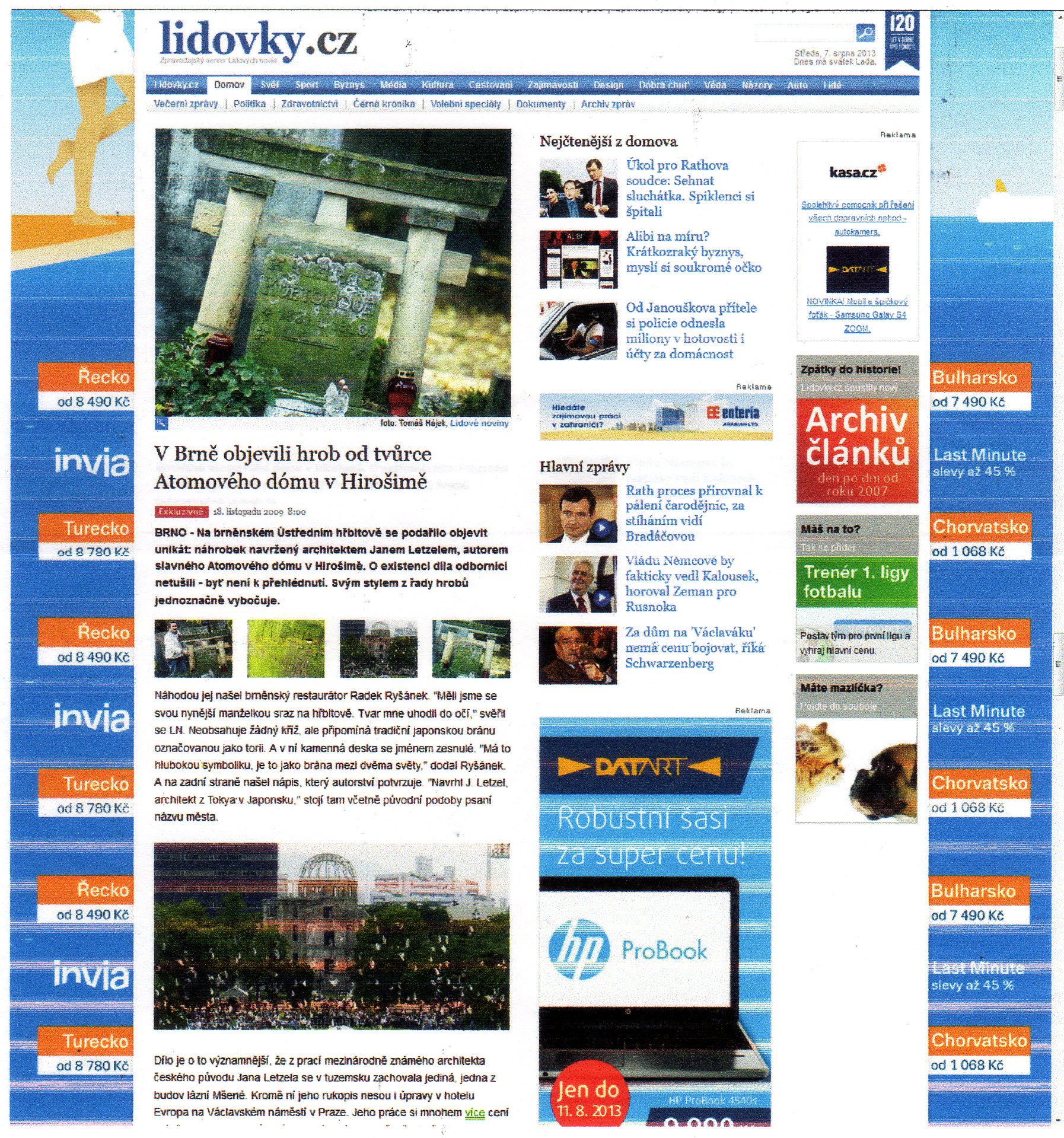
torii,” and that an inscription on the back “confirms Letzel as the author.” According to the Tokyo Shimbun, the stone is sandstone about 1.3 meters high, the grave of a woman named Clara who died in 1910 at twenty-nine; Letzel was in Japan at her death, and how the stone was made is unknown.
Letzel came to Japan in 1907 (Meiji 40), worked at offices in Yokohama and Tokyo, founded his own firm, went home, and returned as a commercial attaché. He himself was hit by the Great Kanto Earthquake of September 1, 1923, lost all his property, saw many of his buildings ruined, went home in November in despair, and died in Prague in 1925 at forty-five. Many works were lost — Kobe’s Oriental Hotel (the third, around 1907) burned in the 1945 Kobe air raid; in Tokyo the Sacred Heart school building (1909) collapsed in the quake, though the main gate remains as it was.
Among them, the one that became a World Heritage site and will remain forever is the Atomic Bomb Dome. Director, playwright, and translator Murai Shimako, known for the “Women of Hiroshima” series on the bomb, published an “Atomic Bomb Dome / Jan Letzel trilogy,” and Czech performances have been staged.
Also
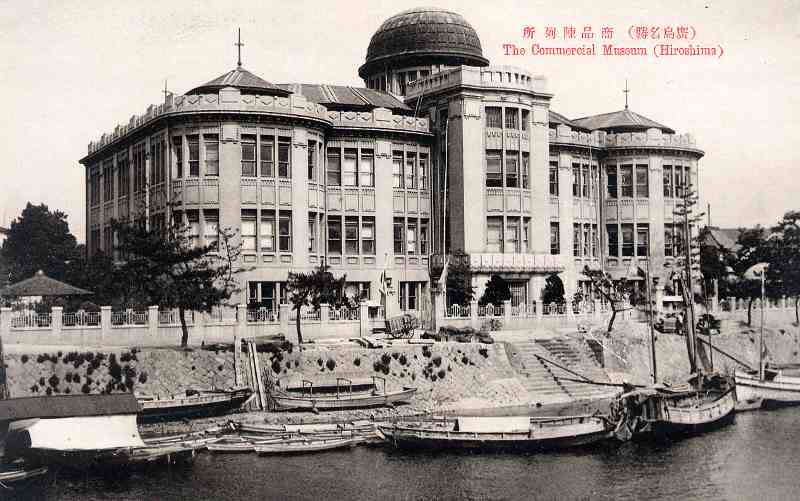
, copywriter Hataoka Noriyuki’s 2007 three-minute documentary “Landscape in the 61st Year: Hiroshima Mindscape” argues for a peace message the Dome itself held even before the bombing. A March 29, 2007 Mainichi Hiroshima edition quoted him: Letzel’s homeland had been under the Austro-Hungarian Empire, and he was drawn to East Asian culture whose background was a dislike of conflict; the Dome’s wall ornaments were hinted by abstract kimono patterns, so a wish for peace was in it before the bomb. “If we call it a ‘symbol of peace,’ that side should get a spotlight too.”
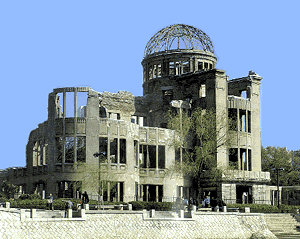
That is war journalism. Now, and all along, it has reported many things from many angles.