
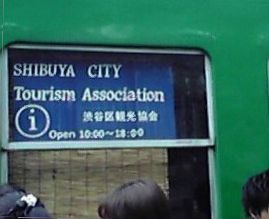
From Takebashi I changed to the Hanzomon Line at Kudanshita and went to Shibuya. In the window of the green monument car on Hachiko Square was a sign that had not been there: “SHIBUYA CITY Tourism Association” = photos right and below. I was told a tourist desk for foreign visitors opened in June.
According to Shibuya Keizai Shimbun, the Shibuya City Tourism Association, jointly set up by Shibuya Ward and the Tokyo Chamber of Commerce, opened it. Every day from 10:00 to 18:00 one dedicated English-speaking staff member is on duty. Depending on the hour
interpreter volunteers also help; some speak Spanish, German, or Chinese. They hand out maps of Shibuya, Harajuku, Daikanyama, and Ebisu; because many foreign visitors are especially interested in Hachiko, they also keep an explanatory pamphlet.
A trial last October drew 417 people in 26 days (three hours a day) — 84 percent foreign, 16 percent Japanese. Inquiries included 237 directions to specific spots such as 100-yen shops, SHIBUYA109, and Yoyogi Park; 143 restaurant and clothing introductions; and 65 transit tips to other areas such as Roppongi and Asakusa. They judged there was demand and made it permanent.
The green frog is a Tokyu 5000 series car (about 18 meters long); 105 were built from 1954 (Showa 29) to 1959. The cab levers and seats remain as they were. In October 2006 the ward received it from Tokyu as a “hub for youth development” and installed it.
The 5000 series combined an ultra-light structure from aircraft technology with cutting-edge electrical gear imported from the United States, and its performance and light style, far from earlier Japanese trains, swept the age. The chubby, charming form and light-green paint earned nicknames such as “blue frog” and “rain frog.” It left the Toyoko Line around 1980, ran on the Oimachi, Den-en-toshi, and Mekama lines, and ended Tokyu service in 1986. From the 1970s cars were also transferred to local private railways such as Matsumoto Electric, aiding modernization. Kumamoto Electric still runs it as the “Keroro Train” on Saturdays, Sundays, and holidays between Kita-Kumamoto and Kami-Kumamoto (sometimes suspended for maintenance).
Shibuya is changing dramatically — the Toyoko Line platforms moved from the second floor above ground deep underground, and redevelopment follows. In the middle of that, the train I rode to school still stands, and somehow it lets you breathe out.
Looking back, when this car came I was disappointed it was not a new duralumin set (the 1970s). How shallow that seems now.