

August 3 was the second Day of the Ox in midsummer (ni no ushi). July 22 was the first; as I wrote on July 23 in this blog, there are two this year.
News has highlighted shops struggling with soaring prices as juvenile eels were overfished and eel was listed as endangered. Mass-market eel since heavy Chinese aquaculture for Japan in the late 1980s made it everyday food—but at a symposium at the University of Tokyo in Hongo on July 22, experts urged stopping overconsumption, treating eel as a feast for special days, and said easy consumption ignoring sustainability hurt fisheries and food culture (The Mainichi Newspapers, July 23 morning edition). What was once luxury became popular—a bitter irony. Turning a resource ill-suited to mass sales into a thin-margin business was the mistake.
I happened to read an episode from when eel was a luxury.
In "Notes: Mito Domain at the End of the Edo Period," author Yamagawa Kikue (1890–1980), a pioneer in women's issues, served as first director of the Women's and Youth Bureau in the new Labor Ministry under the Katayama cabinet in 1947. Granddaughter of Confucian scholar and historian Aoyama Enju, who served Mito as acting head of Kodokan, she drew on ancestral records. Mito, ideologically influential before the Meiji Restoration, suffered bloody internal strife between sonno-joi radicals and conservatives. The book, empirical and from commoners' views, won the 2nd Daibutsu Jiro Prize.
On samurai poverty amid domain power struggles, Naito Chiso—who became a Tokyo Imperial University professor—said: "Mito households were all poor; those not officials often did side work to live... Officials could eat eel; non-officials had to shave skewers. Eating or shaving—that was the cause of power struggles." Eel was a barometer of luxury.
What caught my eye next was the inseparable "skewer." The author continues: "Shaving eel skewers as side work was until recently a Mito specialty souvenir for warrior families; the method was honest and meticulous, and Mito skewers were prized—especially high-grade ones."
As a former Ibaraki resident, I shamefully did not know skewers were a local product. So I
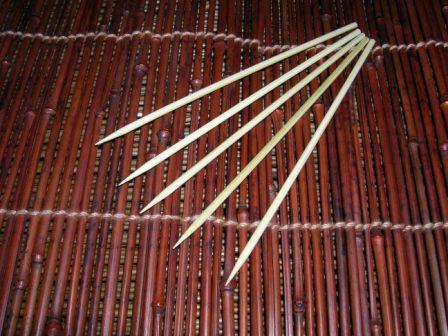
emailed Ogawa Takegushi-ten in Hokota, Ibaraki, and received a thoughtful reply—photo at right from their website.
"Our grandfather made bamboo baskets... In the late 1950s plastic replaced them, so we switched to skewers. Demand existed; many in Mito and Iwama (now Kasama) made them... Cheap imports from Taiwan and China arrived; few make domestic skewers now. Before the earthquake we made many domestic ones, but the factory collapsed and we hardly make them... We import semi-finished bamboo from China, process and ship as Chinese product. What we cut, split, dry, sharpen and sort is sold as domestic—though we cannot make much or advertise loudly. Either way, surviving as a small business is hard."
The earthquake hit even such specialties! Ogawa Takegushi-ten, hang in there!!