

On July 19 we introduced warning posters against using smartphones and other mobile devices while walking — "texting while walking" — at stations including Takebashi (Tokyo Metro and JR East). Many people probably wonder how much effect posters really have. Honestly, I am pessimistic too.
Just then, a clever overseas approach to raising awareness came to my attention. It was featured on greenz.jp, a web magazine that shares "hints for creating the future we want," and involves the New York performance group Improv Everywhere (http://greenz.jp/2013/06/24/seeing-eye-people/). They suddenly appear in everyday streets and unfold improvised entertainment, and their new video uploaded to YouTube, "Seeing Eye People" (http://www.youtube.com/watch?v=kNyTqIsrk0w&feature=player_embedded) is quite brilliant.
The name is a play on the English term for guide dogs, "seeing eye dog," so they call them
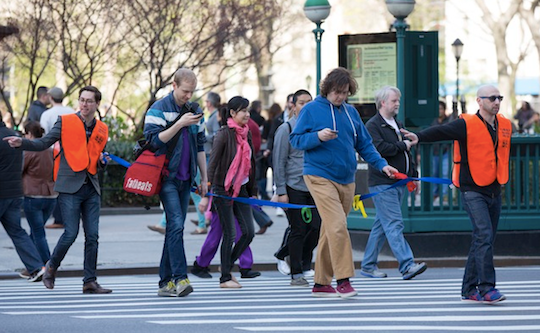
"seeing eye people." As in the photos at upper left and upper right, performers in orange vests act as the "eyes" of people texting while walking, just like guide dogs, and walk alongside them. The texters simply follow, so they can stay glued to their smartphones or iPads — and the images powerfully convey both the absurdity and the danger. The greenz article concludes: "Isn't this a case of 'watch others and correct yourself'? With a dose of self-reflection too."
By the way, texting while walking is not, of course, a Japanese monopoly. A survey by the U.S. injury-prevention organization Injury Prevention (1,102 pedestrians at 20 intersections in Seattle) found that one-third (about 330 people) were either talking on the phone, listening to music, or entering text messages while crossing the road. Those entering text ("texters") took 18 percent longer to cross than others, and texters were about four times more likely to ignore signals or fail to check for cars and pedestrians at intersections. And they keep doing it even though they know it is dangerous. Have they become so dependent they cannot walk without texting?
With more trains now able to play video onboard, wouldn't showing a slightly dark-humored "seeing eye people" clip be quite effective?