

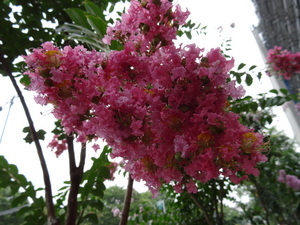
Crape myrtle (sarubobori — "monkey-slippery" for its smooth bark) lines about 200 meters from Palaceside Building's west entrance to Hirakawamon intersection on the east side — 55 trees. Palaceside Building joined the metropolitan "Tokyo Fureai Road Program" from fiscal 2002, cooperating on a greener streetscape; flowers in shades of white, pink, red, and red-purple bloom delicately, undaunted by midsummer sun and record short downpours.
Yesterday's rain was something else — 100 mm in an hour. Even a "bucket turned upside down" downpour is usually about 50 mm per hour. Twice that hit at once; everything went white, like standing in a waterfall. (Sorry — not in a waterfall, just staring dumbfounded out the window from inside Palaceside Building ...)
Crape myrtle's spring buds are rather late among trees, but once blooming starts, the season is long — nearly three months. Of course one flower does not last three months; after each bloom falls, new flowers open on the same branch in succession, so it always looks in bloom. A bit unfair, but this long flowering is one reason for the name "hundred-day red."
Flowers often come with legends; in Asia some countries tell a sad love story for crape myrtle.
Once upon a time, a prince traveling saved a girl offered to the dragon god and fell in love. He had to continue his journey until his mission was done, so he promised to meet again in a hundred days and parted. Just before the hundredth day, the girl died suddenly; the returning prince grieved. A tree grew from her grave and bore delicate red flowers that kept blooming and blooming. Villagers named the flower crape myrtle — surely the girl reborn, still waiting for her lover a hundred days later.
Borrowed from a web page on flower language and legends — a lovely name.