
The other day, over drinks with an acquaintance active in international business at a Palaceside Building shop, I was shown something rare — a banknote. The photo is a bit dark, but count the digits upper right, upper left, lower left: "one, ten, hundred, thousand, ten thousand, hundred thousand..." Fourteen zeros. Center left reads "ONE HUNDRED TRILLION DOLLARS." MILLION (1 million), BILLION (1 billion) I can follow... three more digits and... whoa, 100 trillion?! The unit is "dollars."
Not U.S. dollars, of course. Center top says "RESERVE BABK OF ZIMBABWE" — the Reserve Bank of Zimbabwe. Japan's equivalent would be the Bank of Japan.
Zimbabwe is a former British colony northeast of South Africa; a minority-white "declaration of independence"
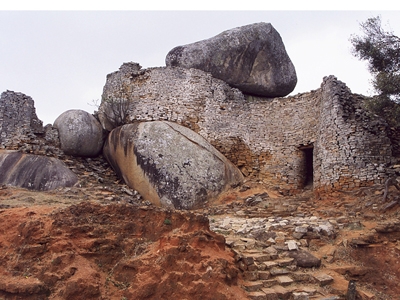
proclaimed "Rhodesia," an apartheid state alongside South Africa, but after the 1980 general election a black majority-led Republic of Zimbabwe was born. The note probably depicts the Great Zimbabwe World Heritage "Acropolis walls"=photo lower right= — a fortress combining natural rock and granite blocks, they say.
The independence leader turned to dictatorship; radical policies like white land seizures wrecked the economy — hyperinflation produced this high-denomination note. Issued around 2008; in 2009 a 12-digit redenomination (100 trillion Z$ → new 100 Z$), so the photo is a pre-redenomination historic piece. (Printed by a German firm — not as cheap-looking as I'd expected.)
Inflation recalls the Weimar Republic (Germany) between the world wars — prices reached a trillion times pre-WWI; one loaf needed 428 billion marks, three times WWI war costs, they say. Zimbabwe holds its own — a photo online showed three eggs on a 100 billion Z$ note, so one egg ≈ 33 billion Z$. Times, conditions and nations differ — which was worse is unclear; my acquaintance says only foreign currency like the U.S. dollar is trusted and daily life has reverted to barter. Naturally.
Abenomics is said to cause inflation. May it stay moderate.