

Fushimi Inari Taisha (Fushimi Ward, Kyoto) is known as the head shrine of some 30,000 Inari shrines nationwide. A colleague on a trip photographed a torii engraved with "Mainichi Building Co., Ltd." =photos lower left and lower right= and the torii bearing "Mainichi Inari Shrine" =photo upper=. The torii is jointly named with Mainichi Newspapers.
The site is midway up Mount Inari behind Fushimi Inari Taisha. Pass the famous "Thousand Torii" and climb to Yotsutsuji, where the view opens over Kyoto. From there, circle to the north
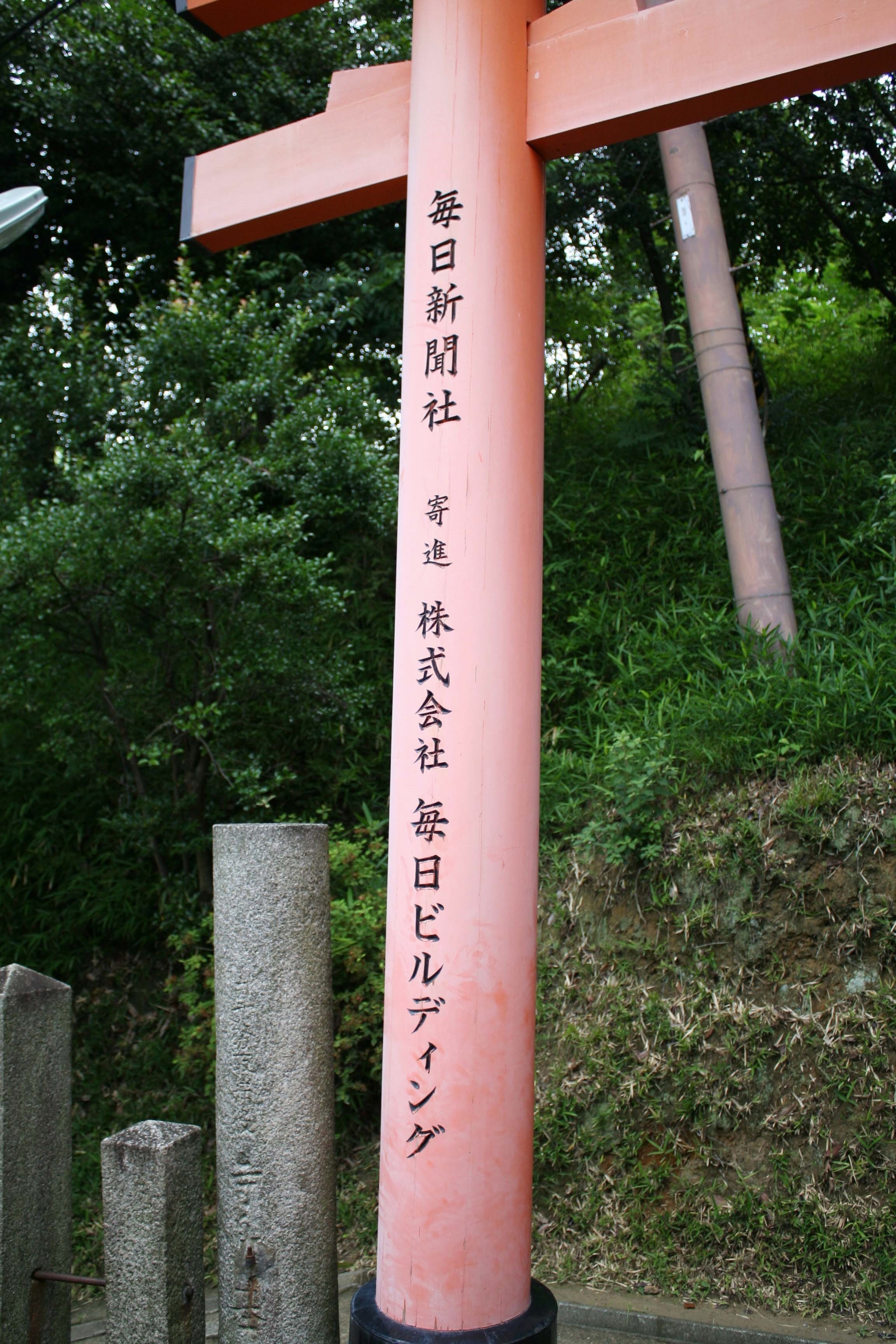
and descend a little. Built around 1907 = Meiji 40. The merger of Osaka Mainichi and Tokyo Nichinichi was 1911 = Meiji 44 (unifying the masthead as Mainichi was 1943 = Showa 18), so before unification Osaka Mainichi built it alone.
Mount Inari is 233 meters; the whole mountain is within Fushimi Inari grounds — about 270,000 tsubo, they say. Some 300 shrines and mounds dot the slopes, including Mainichi Inari; "mountain pilgrimage" is popular. A full circuit takes two hours, with steep stone steps — quite tough.
Mainichi Inari enshrines a branch spirit of Fushimi Inari. Palaceside Building's sibling, the Mainichi Osaka headquarters (Umeda 3-chome, Kita Ward, Osaka), has a branch shrine. Its hall moved with the newspaper — from Higashi Ward (now Chuo) Okawa-cho, to Dojima in 1922 = Taisho 11, then in 1992 = Heisei 4 to the current Umeda headquarters.
Speaking of Mainichi shrines, Palaceside Building's rooftop Mainichi Shrine was founded in 1939 = Showa 8 to commemorate the Mainichi twin-engine transport "Nippon" completing a round-the-world flight — praying for aviation safety. Mainichi Inari, being Inari, is above all for prosperous business. Mount Inari also has "Hirotsuge Inari Shrine," built together. Well — newspapers are business; they'd like ads too.