
This is slightly old news, but in an article in R25, a free paper for young people, Palaceside Building was ranked No. 2 among "Cool Office Buildings."
Issue 320 of the same magazine (December 6 last year)= photo upper = featured an article titled "Visiting Headquarters Buildings That Are Too Cool." The main text focuses on Apple's new headquarters plans and mainly covers buildings overseas, but a chart titled "Japan's Top 10 Cool Office Buildings"= photo lower = was attached. The selections were made by Taro Igarashi, a professor at Tohoku University's Graduate School of Engineering known as an architectural historian and critic. Brief comments accompany each entry; for Palaceside Building it reads, "Its signature feature is two white cylindrical cores, east and west, rising 50 meters."
Getting carried away, I sent an inquiry email from Professor Igarashi's laboratory website — and received the following reply.
"It is a building highly regarded in the history of modern and contemporary architecture. If you look through ordinary books on Japan's modern architectural history, it appears in most of them, so the assessment basically follows that consensus. Even viewed today, it does not feel dated at all."
That was the professor's overall judgment. I am humbled.
Not to boast, but Professor Igarashi's university laboratory was severely damaged in the Great East Japan Earthquake, leaving him "half a disaster victim himself." He toured many affected areas, and his lab worked on the basic design of community centers in temporary housing in Minamisoma and a preservation project for collapsed buildings in Onagawa, among other efforts. He is also known as the organizer of the exhibition "3.11 — How Did Architects Respond Right After the Great East Japan Earthquake?" (organized by the Japan Foundation and others). The show began a year ago at Tohoku University and Paris and is scheduled to tour about 20 cities overseas over two years.
To receive such an assessment from Professor Igarashi — please forgive a little hometown-pride blogging.
By the way, the top 10 are as shown in the table at right. No. 1 is Mode Gakuen Cocoon Tower (Nishi-Shinjuku); No. 3
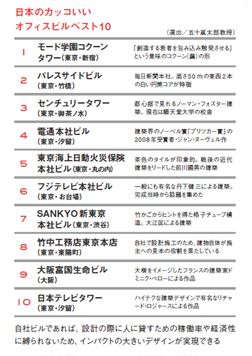
is Century Tower = Juntendo University (Hongo). Below that: 4 Dentsu Headquarters (Shiodome), 5 Tokio Marine & Nichido Fire Insurance Headquarters (Marunouchi), 6 Fuji TV Headquarters (Odaiba), 7 SANKYO Shintokyo Headquarters (Shibuya), 8 Takenaka Corporation Tokyo Main Office (Toyocho), 9 Osaka Fukuoku Life Building (Osaka City), 10 NTV Tower (Shiodome).
Except for No. 5 Tokio Marine (completed 1974), the rest were built between 1991 and 2010 — quite new. Except for No. 8 Takenaka (7 floors) and No. 7 SANKYO (14 floors), all are 20 stories or more, including super-high-rises like Mode Gakuen's 50 floors. Among them, Palaceside Building — opened in 1966, nine stories above ground — feels like it received a truly special evaluation.