

I saw the special exhibition "The Great Journey: The Human Odyssey—A Story of Surviving on This Planet" at the National Museum of Nature and Science in Ueno (website http://gj2013.jp/). Through Sunday, June 9; closed Mondays.
Focused on the long road Homo sapiens—born in Africa 200,000 years ago—spread across the globe from 60,000 years ago, the show is in two main parts. The first follows explorer Yoshiharu Sekino's experiences with indigenous life in rainforests, highlands, the far north, and arid zones to explore how people survived harsh environments, rediscover "the strength of human life," and invite reflection on humanity's and the planet's future. Exhibits include the dugout "Jomon-go" Sekino built and sailed to test the "maritime route" to Japan via Southeast Asian islands and the Kuroshio Current, plus stuffed polar bears and walruses—fun for children too= photo upper left.
The star attraction is the world's oldest mummy= photo lower left. Most people think of Egypt, but even older—about 5,000 years ago—a mummy from the Chinchorro culture of Chile's Atacama Desert makes its first appearance in Japan. Another, slightly scary item: shrunken heads. You may find yourself gasping "Jejeje!" (as in NHK's "Amachan"). Cultures worldwide took heads for religious reasons or as the fruits of inter-tribal war
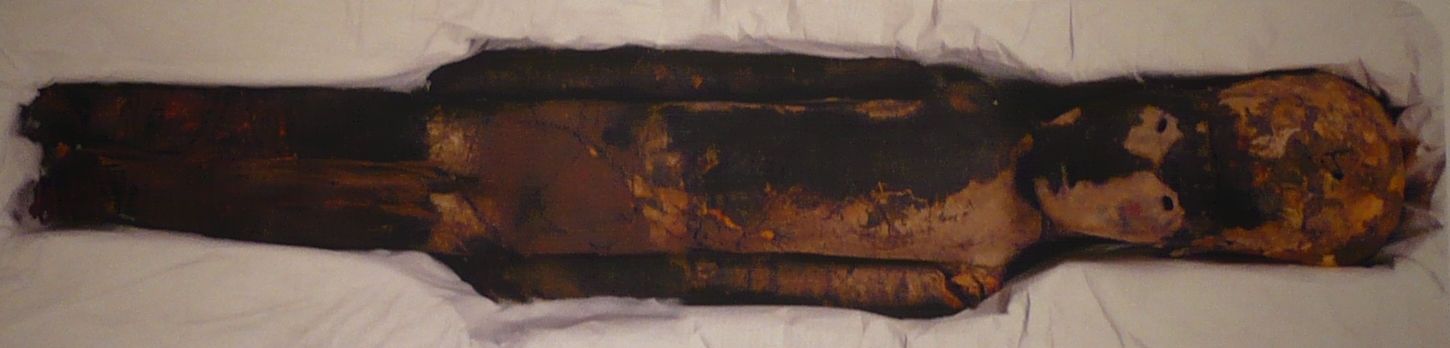
fare; from the mid-19th century Amazonian peoples reportedly sold them as souvenirs to tourists (´∇`). Three specimens from the museum's collection return after ten years.
The second half takes the 3.6-million-year-old Laetoli footprints in Tanzania—where early human ancestors walked as a family
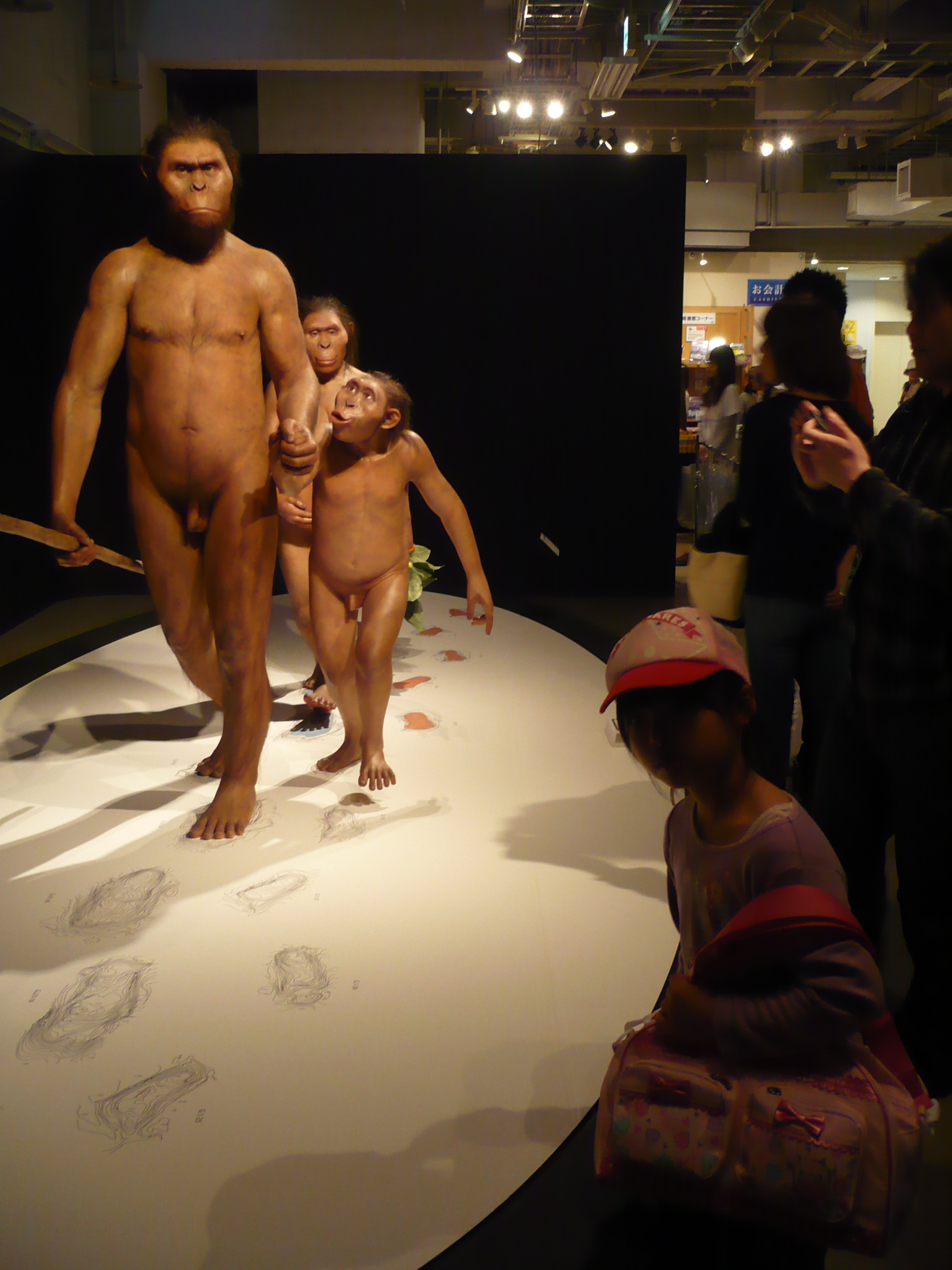
—the oldest such footprint fossil—as a symbol of the Great Journey. Based on scientific data, a restored "family of three" is on display= photo upper right. By the way, Takashi Okamura of Ninety-nine served as the "academic model" for the ape-man reconstruction. He really does look the part.
Open 9 a.m. to 5 p.m.; Fridays until 8 p.m.—so stopping by after work from Takebashi could work well.
It was fascinating, but admission is 1,500 yen for adults, 600 yen for students, 3,600 yen for a family of three. Stingy as it sounds, even though the permanent galleries (600 yen for adults) are included, I wished a national museum might make kids free, or discount those who skip the permanent collection...(・д・`*)