

Sixty-eight years ago, on May 25, 1945 (Showa 20), Tokyo suffered another massive U.S. air raid following the attack on the 24th. Talk of bombing Tokyo often spotlights the March 11 lower-city raid said to have killed more than 100,000, but this day's raid left about 3,700 dead and some 220,000 homes damaged—the second worst among the 106 raids on Tokyo since November 1944 (Showa 19). Mainly Kojimachi, Azabu, Ushigome, and Hongo were hit; it is known as the Yamanote air raid.
The Yurakucho district, where The Mainichi Newspapers had its headquarters, was also bombed and strafed by B-29s. The Mainichi's old building escaped, but Mainichi Hall took a direct hit from incendiary bombs. Fire entered the dome of the Mainichi Tenmonkan—the only planetarium in eastern Japan—spread through ducts, and flames climbed from the fourth floor up; everything above the fourth floor was destroyed. Newspaper publication fortunately continued, but the Yomiuri Hochi and Tokyo Shimbun buildings across the street burned completely, so on the 26th those papers joined Mainichi and the surviving Asahi Shimbun in a joint edition. Both papers continued shared printing at Mainichi and Asahi plants through September 30.
By the way, the Mainichi Tenmonkan (To Nichi Tenmonkan until 1943), lost on the 25th, had published since opening on November 3, 1938 (Showa 13) a booklet titled "Stars, the Universe, and Planetarium Commentary," separate from the pamphlets and postcards we introduced earlier from amateur astronomer Seiji Ogawa's collection.
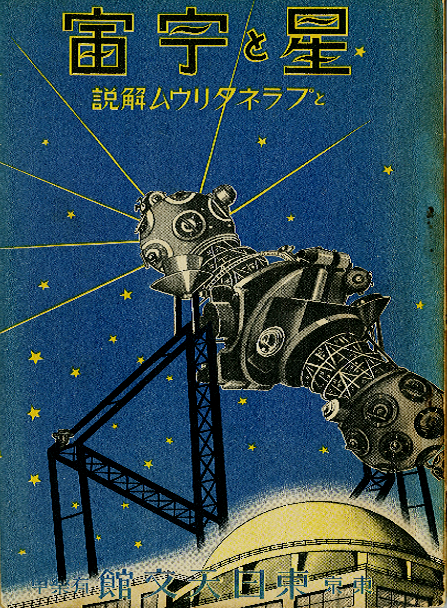
Slightly larger than A5, 120 pages, priced at 20 sen. Written by Keishin Suzuki, B.Sc., head of the astronomy section at the Tokyo Science Museum, it covers five topics—"The Celestial Sphere and Stars," "Seasonal Stars," "The Galaxy and the Universe," "The Solar System," and "The Planetarium"—in accessible language with diagrams and photos, with a romantic touch on the stars. On the planetarium, diagrams and photos of projectors showing stars and the moon explain the mechanism from how it works to what you see, even its precision. It closes by praising the planetarium: "That a planetarium has been built to show astronomical phenomena so closely tied to our daily lives, in so plain and understandable a way, is greatly to be celebrated, whether for the use of astronomy or for the sake of hobby."
That such a planetarium was lost in just six and a half years is truly a shame.