

The Kanda Festival, held for the first time in four years, was a huge success—the "Shinkosai" parade of portable shrines on the 11th, the "Mikoshi Miyairi" on the 12th when about 100 neighborhood mikoshi enter the shrine= photo upper left is from the live blog Kanda Matsuri.ch (http://kanda-ch.blog.ocn.ne.jp/live/2013/05/) showing the Awajicho 2-chome neighborhood association mikoshi entering the shrine, and the grand festival on the 15th.
At this year's festival, students who had begun living locally made a major contribution carrying mikoshi. Students like that had been around before, but the story is about newcomers who joined the festival in a systematic way.
The setting is "Waters" (WATERRAS), a large mixed-use complex built through redevelopment in Kanda-Awajicho, Chiyoda Ward= photo
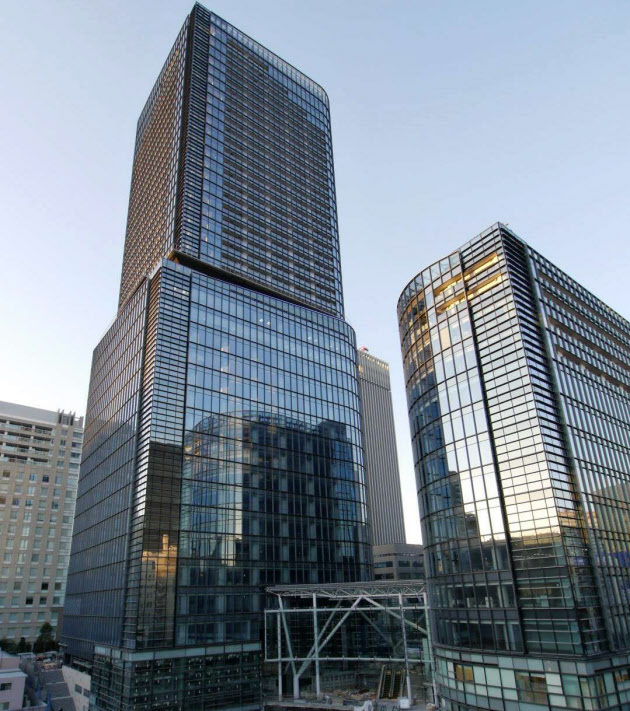
upper right. Close to JR Ochanomizu and Toei Subway Ogawamachi stations, about 15 minutes on foot from Takebashi. On roughly 22,000 square meters stand the 41-story, 164.8-meter "WATERRAS Tower" (offices and condominiums—left in the photo) and the adjoining 15-story "WATERRAS Annex" (commercial floors including a supermarket below the 13th floor—right in the photo). Floors 14 and 15 of the Annex hold 36 units of student housing. The condition for moving in: participation in a point-based community activity program.
The site was formerly Awaji Elementary School, closed through consolidation in 1993. Local residents worked on revitalization and came up with this residency requirement as part of that effort.
The student apartments, owned by a major real estate company, are 20-square-meter one-room units with kitchen, toilet, and bath. Refrigerator, microwave, bed, and other furnishings are included. Rent including management fees is 75,000 yen per month—20 to 30 percent below market. From 69 applicants, 36 residents were chosen after interviews by local residents and other screening. Required community activities use a point system—editing the neighborhood newsletter, beautification projects, and more—with at least 12 points per year needed to renew the lease. Separately, disaster drills are mandatory, and residents must take part in at least one of the festival, sports day, or year-end night patrol.
So most of the 36 took part in the Kanda Festival. At the Mikoshi Miyairi on the 12th, when about 100 neighborhood mikoshi enter Kanda Myojin one after another, male students worked hard carrying the Awajicho 2-chome association mikoshi. Female students served as tekomai—leading the procession of the Nakakanda Jusankacho Rengo—with male-style geisha dress to guide the festival float.
We look forward to seeing what this stylish town-revitalization effort achieves.