
The Kanda Festival began on the 9th. On the evening of the 8th I peeked into the precincts = photo upper = — not much different from usual, yet the air felt festive. Among seven festival days, the Shinkō-sai parade on the 11th and the 100 neighborhood mikoshi entering the shrine on the 12th peak in excitement. Held every two years since Edo times; canceled two years ago after the Great East Japan Earthquake — this year after four years. Everyone involved seems extra fired up.
Kanda Festival ranks among Edo's three great festivals with Sannō (Hie Shrine) and Fukagawa (Tomioka Hachiman), and among Japan's three with Kyoto Gion (Yasaka) and Osaka Tenjin (Tenmangū).
Opening "Hōren Mikoshi Senza-sai" on the evening of the 9th: in darkness with gagaku, purified priests in white transfer the divine spirit from the main hall to the three hōren mikoshi — a solemn rite.
To boost the festival, the special exhibition "Edo Spirit in Festival Scrolls — 'We're Edokko Too' 'Kanda's Festival'" runs at Arts Chiyoda 3331 (6-11-14 Sotokanda, Chiyoda Ward) through the 19th, 12:00–19:00 (until 20:00 on the 12th), free admission ("http://kanda-sp2013.3331.jp/"). A ward gallery in a closed junior high near Kanda Myōjin — one minute from Suehirochō on the Ginza Line from Takebashi by subway.
Besides precious floats and doll figures, it shows origins, early Shōwa festival footage, and neighborhood happi coats.
Highlight: the "Kanda Myōjin Festival Scroll" from Edo–Meiji. The original, owned by Kanda Myōjin, splits into three long rolls totaling about 50 m. Author unknown; a well-preserved copy was acquired and designated a Chiyoda Ward tangible cultural property in April. A high-resolution scan replica is on display. Depicting festivals from Hōreki to Tenmei (late 18th century), towns
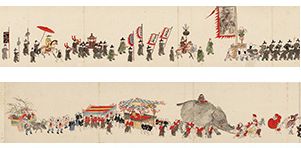
people in Chinese warrior tales and Japanese folklore costumes pull floats — vividly, humorously. Kintarō rides a boar — surely no real one that big; maybe a mascot suit = photo below. Edo folk loved this stuff. Anyway, a fun scroll to view.