
Over the weekend I went to see Rubens. At Bunkamura the Museum in Shibuya, Tokyo, the exhibition "Rubens: The Glorious Antwerp Workshop and the Italian Origins" (organized by The Mainichi Newspapers and others) runs through Sunday, April 21= photo upper: near the entrance. Eighty-four works gathered from six countries — what a feat. I feel as if I saw a lifetime of Rubens.
Peter Paul Rubens (1577–1640), the painter who represents 17th-century Baroque art, grew up in Antwerp in Flanders (present-day northern Belgium). After serving as a court painter in Italy for eight years from age 23, he returned home, set up a workshop in Antwerp, and produced one masterpiece after another, including "The Life of Marie de' Medici" (Musée du Louvre). From the 1620s he also famously served as a diplomat in peace negotiations between Spain and the Netherlands.
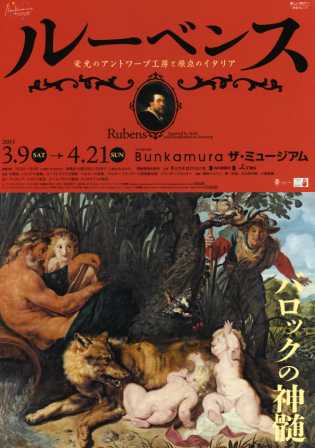
The highlights this time are a self-portrait and "The Discovery of Romulus and Remus," depicting twin brothers raised by a wolf= on the flyer in photo lower = (Romulus and Remus are said to have founded ancient Rome). Most of these oil paintings are reportedly being shown in Japan for the first time.
The exhibition focuses not only on his Italian period but above all on the activities of the Antwerp workshop, and the prints he personally directed are especially striking. Painters are often imagined as solitary seekers, but Rubens seems to have been a little different.
According to feature articles in The Mainichi Newspapers, workshops at the time were the gateway to becoming a painter in Europe. Students paid tuition to learn technique, then were hired as assistants and painted on the master's instructions. What made Rubens's workshop stand out was how systematically it was run to take on major commissions: Rubens would paint a small oil sketch, obtain the client's approval, assistants would enlarge it on a large canvas from that model, and Rubens would finish with final touches. His workshop reportedly had at least 25 assistants (among painters who went independent, Anthony van Dyck, known for portraits of the English upper class, was perhaps the most successful).
There is an display that reveals how such a workshop operated. Several similar prints are shown with notes such as "make the hair fuller here" and "deepen the shadow on this body," and you can compare them with the corrected versions — quite interesting.
Another point: amid paintings centered on religious subjects, "specialist painters" who excelled in particular fields began to appear — Bruegel for flowers, Snyders for animals, Wildens for landscapes — and Rubens tried collaborative works with them. "Bear Hunt," painted jointly with Snyders, is another highlight.
Open daily through April 21. Same-day tickets: adults ¥1,500, high school and university students ¥1,000, elementary and junior high students ¥700. After Tokyo, the show travels to Kitakyushu Municipal Museum of Art, May 28–June 16, and Niigata Prefectural Museum of Modern Art, June 29–August 11. Images and explanations of major works are on the organizer's site (http://rubens2013.jp/index.html).