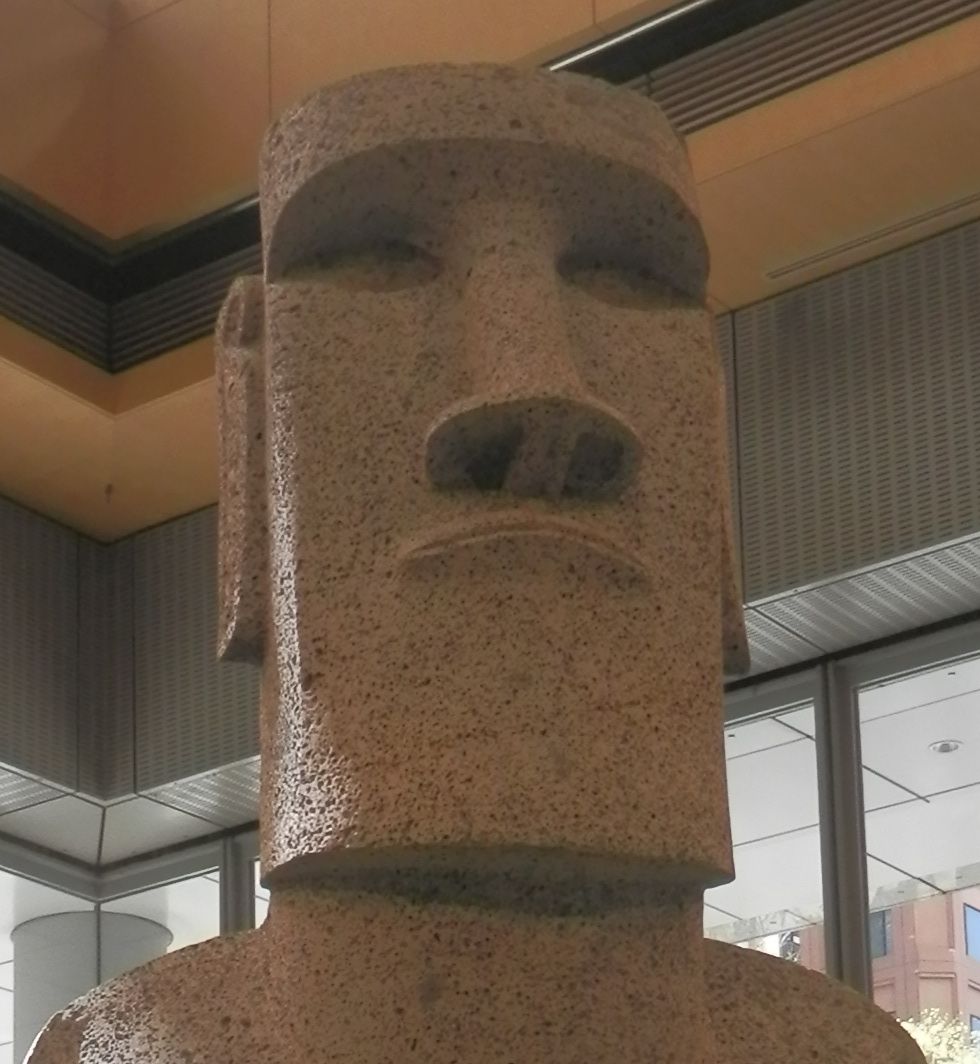

One subway stop from Palaceside Building, getting off at Otemachi Station, I went to "Moai: Living for the Future" at Marunouchi Building (through the 28th)=photo upper=. As I wrote on this blog on the 19th, the moai on display is 3 meters tall and 2 tons (excluding the pedestal), bound for Minamisanriku Town, Miyagi Prefecture. The face has impressive force as well=photo lower=.
Moai 1–10 meters tall, weighing up to more than 80 tons, are said to number over 1,000 on tiny Easter Island — about a quarter the size of Awaji Island. Why were so many giant statues built? How were the heavy stone figures transported? On an island cited as an example of vanished civilization, many mysteries still linger. What was the truth?
The island has no historical records (hieroglyphs remain but are undeciphered), but the accepted view runs as follows. — Polynesians arrived by large canoe and civilization began, though the date is disputed from the 5th century to around 1200 AD. Food plants they brought, such as coconut palms and breadfruit, did not thrive; repeated slash-and-burn farming eliminated the forests by the late 17th century. With population growth and resource depletion, fighting among island groups intensified and civilization collapsed. Moai seem to have been built from around the 11th century as religious structures based on ancestor worship, but with civil decline production stopped around the 16th century and they were destroyed instead. The island population, said to have reached 10,000 at its peak, was 2,000–3,000 when Westerners set foot on the island in the 18th–19th centuries. In the late 19th century disease (said to be smallpox) was introduced and islanders were taken as slaves, reducing the population to around 100. Along with descendants of the indigenous people called Rapa Nui, immigrants after Chile's annexation in 1888 are included; about 4,000 people live there now —.
An article exploring the island's rise and fall appears in National Geographic Japan, July 2012; a digest can be read on the web (http://special.nikkeibp.co.jp/ts/article/ac0b/139205/201207/index.html). The outline is as follows.
Pulitzer Prize–winning writer Jared Diamond, in his 2005 book Collapse, cites it as a clear case where reckless resource development brought societal collapse, and argues moai hastened that collapse. As symbols of chiefs' power: ① they competed to build larger statues ② statues were laid on wooden sleds and dragged along wooden rails ③ transport required vast timber and labor ④ more people meant more food ⑤ more land was cleared... environmental destruction accelerated, he says. Against this, Terry Hunt of the University of Hawaii and others hold that islanders were not responsible for environmental ruin. ① sharp teeth marks of Pacific rats were found on extinct palm nuts ② rats came on the same canoes as migrants ③ rats spread across the island in years and ate palm nuts, driving forests to extinction — they infer. On moai transport, they say statues were walked upright, swaying left and right, so work needed few people and no wood — denying massive logging for moai.
Why not gaze at a moai in the city center and let your thoughts wander into mysteries far from everyday life?