

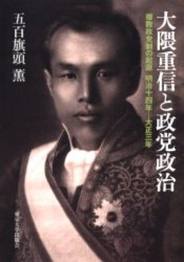
Last week (March 8), I introduced "Meiji 12: By Imperial Command—'Jinbutsu Shashincho,' Portraits of Some 4,500 People" at the Sannomaru Shozokan in the East Gardens of the Imperial Palace, near Takebashi. "This is the first public showing of the album"—but the photos were not entirely kept from the outside world. The elder statesmen photographed surely obtained their own pictures, and some were reprinted as postcards and widely circulated. For example, the photo of Okuma Shigenobu in his youth (around forty) that I introduced last time appears on the cover of Kaoru Iohata's book "Okuma Shigenobu and Party Politics"=photo lower.
While researching such matters, I unexpectedly found something interesting—an article "Meiji Album: Sepia Postcards" in issue 61 (September 2005) of the newsletter "Net Pinus" on the website of Yushodo Books (Sakamachi, Shinjuku), which handles Western antiquarian books (http://www.yushodo.co.jp/pinus/61/meijiphoto/index.html). It was full of photos of elder statesmen, including some from the Imperial Palace album. The caption reads as follows.
"An old album quietly breathing in a corner of an antiquarian book fair in London. Open it and photographs of famous people of the time are pasted edge to edge. Portrait photos that have matured their sepia depth over a hundred years. Photos of those historical figures like this? You may find unexpected discoveries."
Imagine—a Yushodo associate searching for something good, in a distant foreign land, happening upon such an "Album"? Amid nostalgia, might they not have felt something like pride?
Beside each photo is a brief introduction in Japanese with name and title; below are inscriptions in English with names and the like. In every age there seem to be "celebrity maniacs." Such Japanese collectors' albums must have passed into British hands.
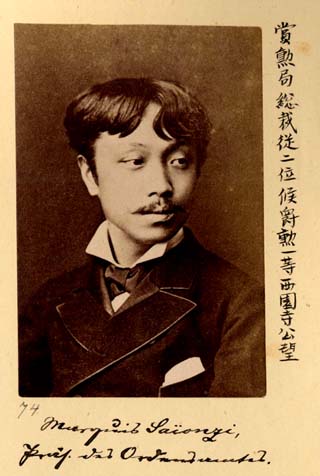
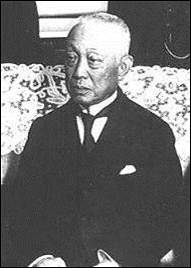
Where I noticed, Okuma, Katsu Kaishu, and Saionji Kinmochi—who served as the "last genro," advising Emperors Taisho and Showa—matched photos from "Jinbutsu Shashincho."
Saionji in the photo at lower left (1849–1940)—if "Jinbutsu Shashincho" was made around 1879, he would be in his late twenties. From history class and books, we remember the photo at lower right from near the end of his life, when he moved to settle affairs after the February 26 Incident. Each has its own flavor.
The "Album" has three sections—"Warriors Active in Modern Japan," "Celebrity? Imperial Couples a Hundred Years Ago," and "Winners and Losers! Descendants of Domains"—featuring 30 people in all. In "Descendants of Domains," you can see the expressions of Tokugawa Yoshinobu, Matsudaira Katamori, Mori Motonori, Shimazu Tadayoshi, and others, as in the top photo.