

Bright yellow little flowers are clustered everywhere. Mahonia flowers have begun to bloom in plantings at Kitanomaru Park and before the National Archives, near Palaceside Building in Takebashi, Tokyo. The leaf margins are spiny and resemble holly used in Christmas decorations, but mahonia belongs to the Berberidaceae—the same family as nandina with red berries—while holly is Oleaceae, and holly blooms in late autumn, a completely different species.
Native to Taiwan, China, and the Himalayas, it was brought to Japan in the Edo period; oddly, the scientific name is Mahonia japonica—"Japan" in the name. Mahonia honors an American botanist. The fruit that follows the flowers are small, deep purple grains dusted with white powder like blueberries.
What is interesting about mahonia is the flowers blooming now. The flowers are small and may be hard to see
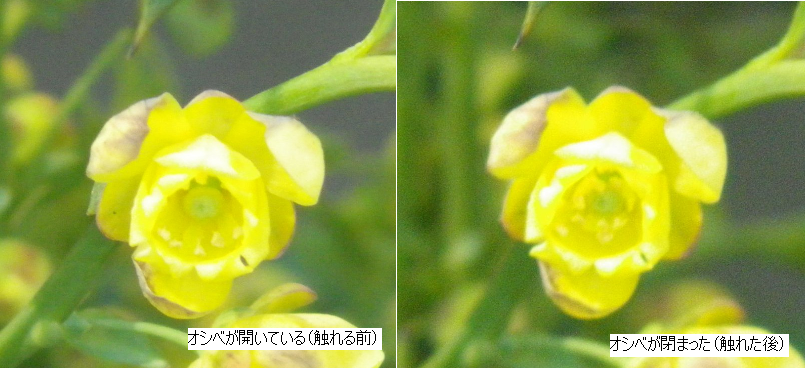
—but if you lightly touch the stamen filaments spread around the pistil with something needle-fine, they suddenly move toward the central pistil and close. Mahonia has six filaments, but only the one touched moves. It is not a carnivorous plant—it does not trap insects with filaments. The mechanism helps insects that enter for nectar stay inside and carry pollen on their bodies, raising the chance of pollination. There is even an AKB song, "Stamen, Pistil, and the Night Butterfly," but this flower too has an elaborate mechanism for preserving the species.