

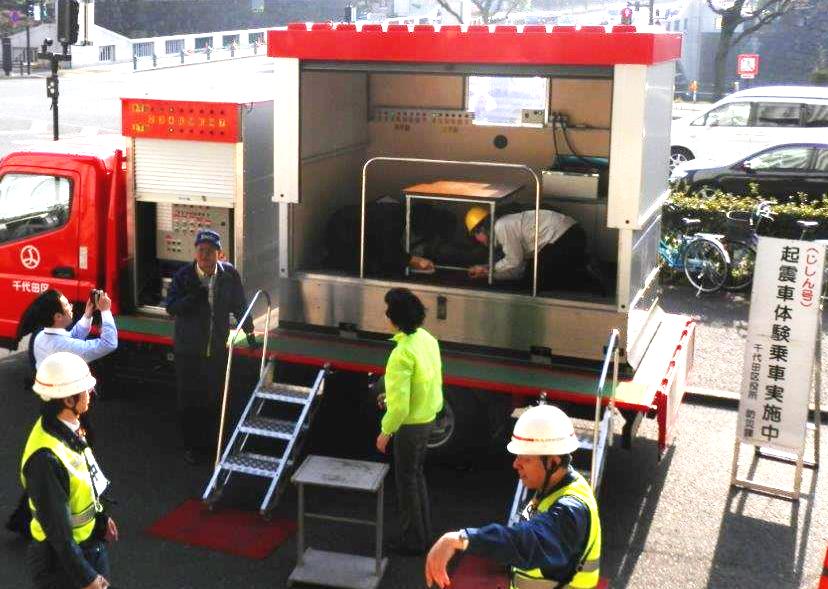
On the roof of Palaceside Building in Takebashi, Tokyo, a spring comprehensive fire drill was held from 2:30 p.m. on Thursday, March 7, with about 650 tenants and building staff participating. This time an earthquake simulator vehicle from Chiyoda Ward came to the west entrance, so participants could actually feel earthquake shaking—and with the second anniversary of the Great East Japan Earthquake approaching, everyone worked through the drill with serious expressions.
The Palaceside Building Joint Fire Prevention and Disaster Preparedness Council, organized by all building tenants, holds this twice a year in spring and autumn. The drill began on the assumption that an earthquake causing very strong shaking had struck the Tokyo area. After initial-response training—emergency announcements, securing exits, ensuring visitor safety, in-building emergency inspections, and assessing damage—a fire broke out in a third-floor office and was spreading, an all-building evacuation advisory was broadcast, and everyone evacuated to ground level via stairs and emergency stairways.
Afterward, participants gathered on the roof for hands-on initial firefighting with fire extinguishers and indoor hydrants, and AE
D operation, stretcher-making first-aid drills, and smoke-experience training—walking through a tent filled with smoke so thick you can barely see ahead.
At the earthquake simulator, which reproduces shaking from intensity 4 to 7, participants crawled under desks and held desk legs while actually feeling shaking that gradually grew stronger.
Finally, Ritsushi Ishii, chief of the Prevention Division at Kojimachi Fire Station, reviewed the drill: "People cannot do what they have never tried when the moment comes. Whether evacuating or using a fire extinguisher, having actually experienced it lets you recall how in an emergency. Daily training, repeated, is what matters."