

Cold days continue, but the day after tomorrow is already March—called the month of flowers, blossom viewing, and dreams. It turns warmer toward spring and lifts the spirits, yet spring haze often makes stargazing less than ideal.
Perhaps for that reason, the celestial guide in a 1941 (Showa 16) pamphlet from the Tō Nichi Planetarium at Yurakuchō—the first planetarium in eastern Japan, in the Tō Nichi Kaikan building of the Tokyo Nichi Nichi Shimbun, predecessor of The Mainichi—was themed "Antarctic Night Sky," far from Japan's heavens. The commentary was written by Hocho Nojiri, known as a scholar of English literature and essayist, translator who named Pluto in Japanese, and folklorist of astronomy.
The planetarium apparently projected a year of Antarctic skies while explaining. As a prelude it introduced the March–April Antarctic night sky from the expedition records of U.S. Rear Admiral Richard Byrd, famous for polar flights. Rendered in old kana spelling, in modern prose: "On April 19 the sun bids farewell to the Antarctic day; for several days before it sinks lower day by day along the northwest horizon. Colors grow delicate and refined. High cirrus swirls in rich hues like tropical plants—yellow, gold, green, pale rose, indigo—splendor beyond words, shifting subtly even as you watch. The upper sky is dyed a bold, clear Atlantic blue; north and south horizons smoke with rose mist. Cliffs, capes, and snow peaks at Whale Bay carve long shadow furrows; hollows on the quay gleam with light crawling like living things. ..." It conveys the splendor of an unknown continent and makes one want to go.
Then: "Night flows in deep and vast. Magnificent constellations wheel in rings; the aurora begins a dizzying (? as in original) dance (ballet)." On the aurora: "Colors of an infinite prism flow, melt, bleed, and divide into beautiful complex rhythms, as if day were in spring love." Turning around, "one's shadow trails remarkably large and long—not seeming human."
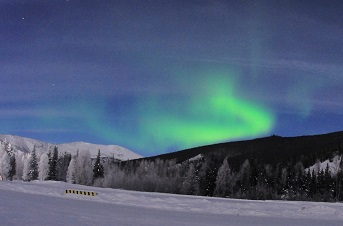
Few Japanese at the time had seen the aurora; through planetarium images and the pamphlet cover and text they must have felt something fantastically romantic.
This pamphlet is from the collection of amateur astronomer Seiji Ogawa; captivated by the aurora's beauty, he sent a photo he took in Alaska=photo. People say seeing the aurora changes one's worldview—that is how captivating a celestial show it is.